
Your cart is currently empty!

An Armchair Guide to Quantum Mechanics
- This event has passed.
October 28, 2025 @ 6:00 pm – November 18, 2025 @ 8:00 pm CET

160 people are attending An Armchair Guide to Quantum Mechanics
An Armchair Guide to Quantum Mechanics
Presented by Jonathan Allday
A semi-serious approach to one of the most important fundamental theories in physics
10 sessions from October 28 – November 18
7 one-hour lectures and 3 sessions of group conversation and Q&A
9am PST / 12pm EST / 5pm GMT / 6pm CET
All sessions are live and all participants will receive the RECORDING.
What is quantum mechanics?
More than 100 years ago, the founding fathers were faced with a series of experimental results that confounded their understanding regarding the nature of reality. Einstein never forgave Nature for doing this to him. Heisenberg had to run away to an island to figure it out. Pauli ended up going to Jung for analysis.
Gradually, they came to a new understanding—Quantum Mechanics—but in the process, they had to throw away virtually all of the old physical picture of particles colliding and interacting like tiny billiard balls. Instead, we now have shifting probability waves existing in an implicate layer of reality and manifesting in explicate results. Our very language and concepts struggle to cope with expressing in words what is clear mathematically. Bohr had to invent a new form of double-think, complementarity, to try and ride the paradox: Nature expressing herself in both wave and particle forms, within the same experiment.
Why is it important?
Quantum mechanics, and the theories built from its foundations, is our fundamental theory of matter and forces. It underpins everything we understand about the nature of our universe. In the earliest moments of creation, fractions of a second into the Big Bang, quantum theory governed the structure and evolution of our young cosmos. Delicate measurements of the universal ‘heat map’ spread across the sky, reveal aspects of this quantum driven period.
Along with the awe-inspiring beauty and depth of the physics involved, quantum theory also has profound implications for our technology: from computer chips, MRI scans, communications and quantum computers.
Fundamentally, quantum mechanics is the most radical recasting of the nature of reality that we have ever experienced. The world is far stranger, and more supple, than we are led to believe.
Why should people have a basic understanding of QM?
It seems clear that the rigidly materialistic paradigm is crumbling, and we don’t yet know what is going to replace it.
We’re at a delicate time. On the one hand some of our political masters seek to undermine the expertise and results of the scientific community, replacing Truth with Story. On the other, enthusiastic and well-meaning groups working to assemble new paradigm thinking are promoting quantum ideas as a universal panacea for mind, body, spirit and anomalous experience.
Wider groups are trying to ride the turbulent waves and look for some understanding they can hold to. In order to steer between rigid scientism on one side and some of the flakier philosophies on the other, it helps to know a little of what quantum theory is really saying about the world
Who are our audience?
High school students
Retirees looking for new areas of interest or wanting to brush up on the latest thinking and developments
People who enjoy reading popular science books and periodicals
People who experienced poor teaching in their science classes at school and would like to start over in their physics education
People who just enjoy learning
How do these presentations differ from other online QM series?
It’s a no-math introduction—sigh of relief!
In addition to the weekly talk with Q&A there will be a weekly ‘conversation bar’ where participants can discuss the ideas of the week with each other and the course presenter, if available.
There will be no keeping away from philosophical issues—the nature of reality is in question here!
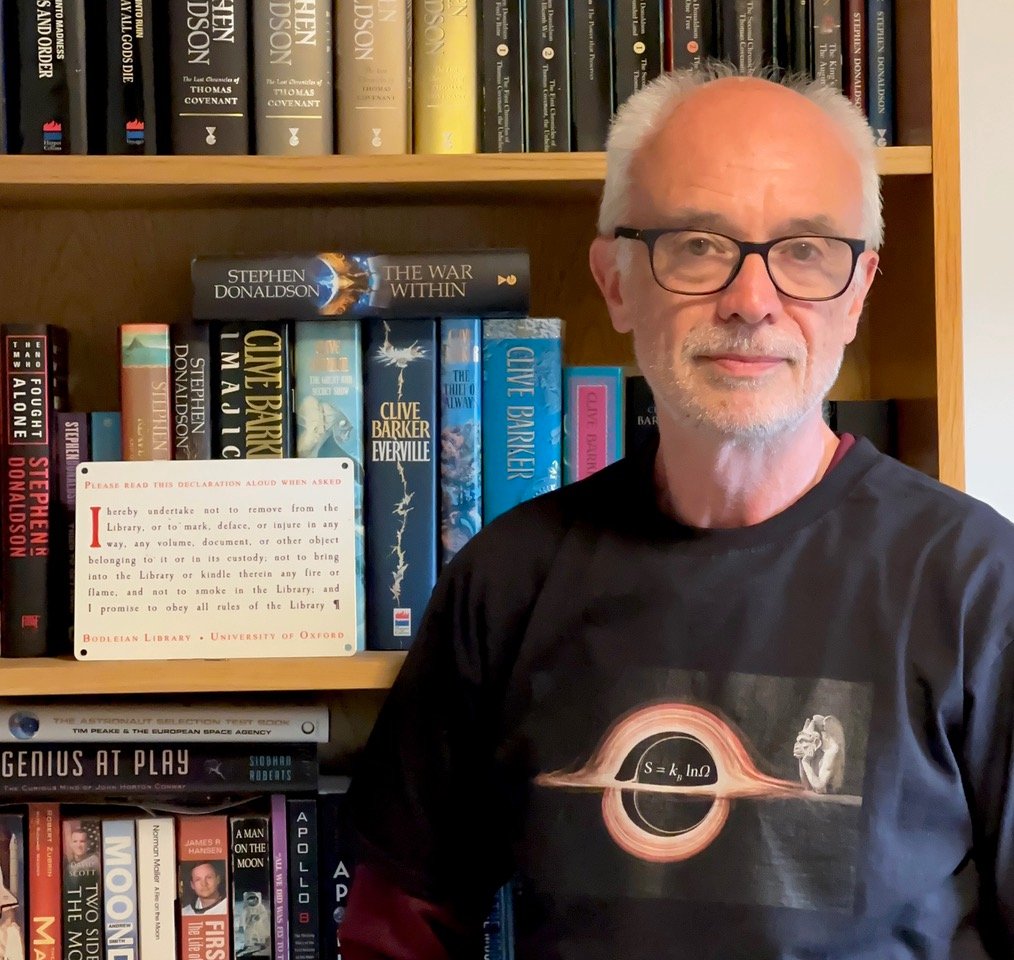
JONATHAN ALLDAY took his first degree in Natural Sciences at Cambridge, then gained a PhD in particle physics in 1989 at Liverpool University. For a period, he worked at the particle physics research centre, CERN, but not as a cleaner.
For 30 years Jonathan taught physics to high-school students in a range of schools across the UK. In addition, he ran summer schools for the Open University, helped devise new physics curricula and a new course in the history and philosophy of science for 16–18-year-olds. For a period, he was co-editor of Physics Education magazine and has contributed more articles to Physics Review than anyone else in its 35-volume history.
He is an author of science textbooks, has contributed to an encyclopaedia for young scientists, and has written on aspects of the history and philosophy of science.
Sessions
Session 1: Not even wrong…
Tuesday 28th October
The fall of classical physics and the rise of the quantum world.
Amplitudes/wave functions, and the probable outcomes of experiments.
Conversation and Q&A
Thursday 30th October
Session 2: Come on everybody, let’s do the twist…
Saturday 1st November
The mysterious quantum property known as ‘spin’. Particles have it, photons have it, but do we really understand what it is?
Session 3: Spooky action at a distance
Tuesday 4th November
When the left hand implicately knows what the right hand is doing. Einstein’s problem with quantum theory. The work of John Bell and the radical undermining of reductionism.
Conversation and Q&A
Thursday 6th November
Session 4: The Measurement Problem
Saturday 8th November
Is quantum theory a 32 regular or a 36 long? Or more seriously…
Why does anything happen in the quantum world? The astonishing fact is that quantum theory relies on a mysterious process that is not fully understood and is not present in the standard mathematics.
Session 5: Interpretations
Tuesday 11th November
More than 100 years later, we still can’t agree what it means. Some people feel that quantum theory can only be understood in the context of many partially overlapping worlds. Others think that there is an unbridgeable and unknowable divide between the classical and quantum worlds. Most just ‘shut up and calculate.’ We, however, are made of sterner stuff so we ask the question: ‘What does quantum theory tell us about the nature of reality?’
Conversation and Q&A
Thursday 13th November
Session 6: Bohm and Hiley
Saturday 15th November
In which our heroes seek to replace the traditional approach to quantum theory with something more satisfying, from an ontological perspective.
Session 7: Quantum Snake Oil
Tuesday 18th November
Would you buy a used quantum computer from this man? What are quantum computers? Why are they attracting so much funding and have they been over-promised?
Who's coming?
160 people are attending An Armchair Guide to Quantum Mechanics