
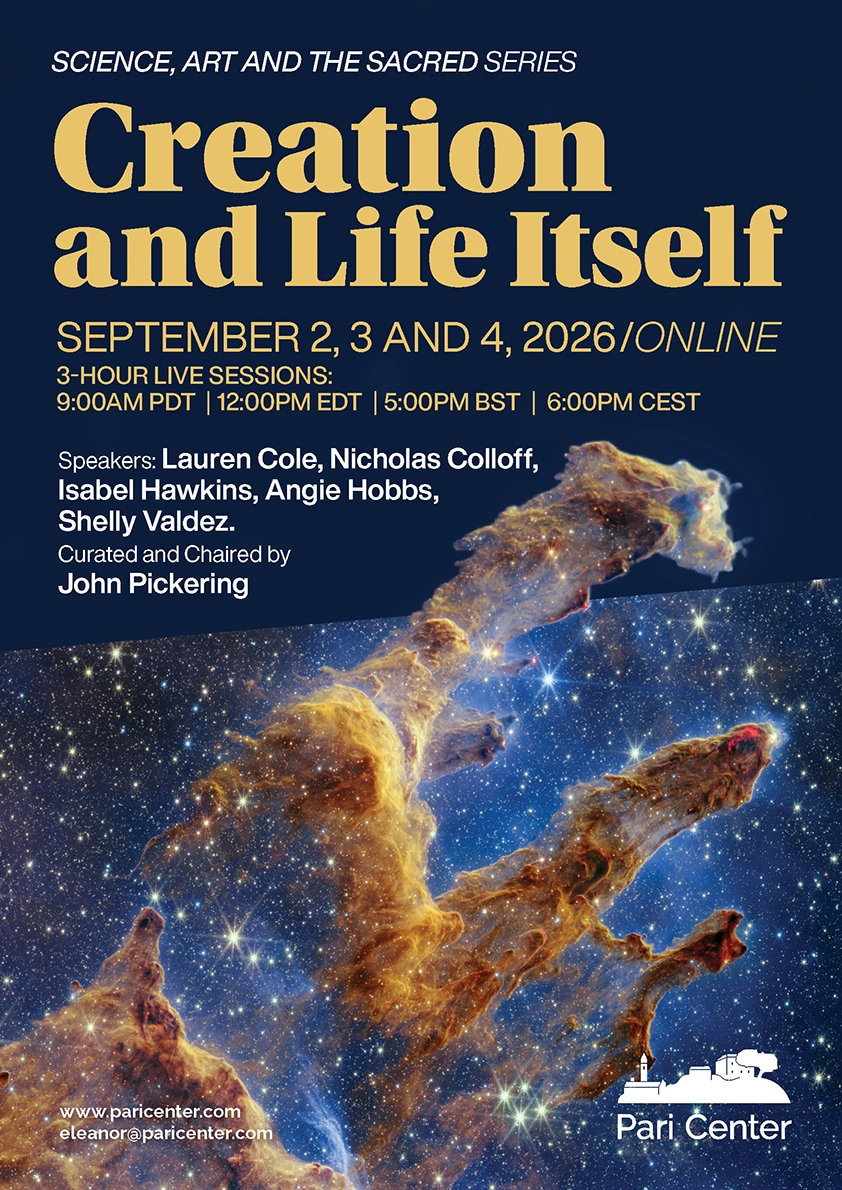
Creation and Life Itself
- This event has passed.
September 2 @ 6:00 pm – September 4 @ 9:00 pm CEST
68 people are attending Creation and Life Itself
Science, Art and the Sacred Series
Creation and Life Itself
What does it mean to be human — and creative — in an age of AI?
At its deepest level, creativity is about far more than making art, music or poetry. Life itself is an act of creation.
Join us for three live online gatherings exploring creativity through philosophy, science, Indigenous knowledge, mysticism, poetry and the sacred — and asking what these different ways of knowing can tell us about what it means to be human today.
September 2, 3 & 4, 2026
9:00am PDT | 12:00pm EDT | 5:00pm BST | 6:00pm CEST
Three 3-hour live sessions • 9 hours of presentations, conversation and Q&A
All registered participants receive recordings of the complete event.
Three days. Six remarkable voices. One fundamental question.
What does it mean to create — and to be part of a living, creative world?
Over three days we will encounter Plato and the creative imagination with Angie Hobbs; the extraordinary authority of medieval women mystics with Lauren Cole; Indigenous creation stories and living knowledge with Isabel Hawkins and Shelly Valdez; paradise, imagination and the spiritual life with Nicholas Colloff; and poetry’s response to ecological catastrophe with Peter Reason.
Together, these perspectives invite us to reconsider creativity not simply as something humans do, but as something fundamental to life itself.
Curated and Chaired by: John Pickering
Program
Wednesday September 2
The Pregnant Philosopher with Angie Hobbs
Medieval Women Mystics: Authority and Suppression with Lauren Cole
Thursday September 3
YAKANAL Indigenous Cultural Exchange: A Catalyst for the Creative Process with Isabel Hawkins and Shelly Valdez
Friday September 4
One Foot in Eden: Paradise Lost and Found with Nicholas Colloff
Will there be singing? What can poetry say at a time of catastrophe? with Peter Reason
Join us live from wherever you are
Come for three days of ideas, conversation and reflection on creativity, life and what it means to be human.
There will be opportunities for questions and discussion throughout the event, and all registered participants will receive the recordings, so you can take part even if you cannot attend every session live.
Standard Ticket: €75
Solidarity Ticket: €40 for those experiencing financial difficulty
About the Event
At its best, being ‘human’ means being creative. Here, ‘creative’ means more than just poetic language or beautiful images. It speaks to something primordial in nature, since life itself is creation. Our meeting will look at the complementary ways in which science, the humanities and spiritual traditions recognise this and how that might inform the lives we lead, singly or collectively.
All human cultures have Creation stories. They reflect our wonder at life itself and the enchanting diversity of Creation that it brings forth. To tell and re-tell the stories is part of being human.
Science is sometimes accused of disenchanting Creation; in fact, it has enhanced it, since the wonder remains. Scientists like David Attenborough express as much love for living things as poets or mystics have done down the ages and as people living in animistic cultures do now.
Animistic Creation stories are of a transformative relation between beings of all kinds that continually and reciprocally bring one another into existence. So, in that view, simply living and being human is to be creative, where ‘creative’ means more than just making poetic language or beautiful images.
Luckily, we live in a time when science, the humanities and the arts are becoming more open, in complementary ways, to recognising this. Our meeting will look at how that might inform the lives we lead, singly or collectively.
We will investigate what ‘being human’ and ‘being creative’ might have meant in the past, what it means in our time. We will look at creativity in science, in the arts and humanities and in spiritual traditions, paying particular attention to women’s voices, those heard and those not. We will, for example, hear from speakers on Hildegarde of Bingen and Julian of Norwich, as well mystical traditions from South American cultures.
Being human, all too human, is difficult. Being more than human, particularly so. Creativity in some sense extends, even transcends the human condition, and we will explore what philosophy and the humanities have to say about that.
Now is a particularly appropriate time to do it, as both creativity and what it is to be human are brought into question by the rise of the machine.
Speakers and sessions
Click on a title to expand
Plato stimulates creative thought in a variety of ways, all aimed at stimulating our non-rational as well as our rational faculties. In order to explore fundamental ethical questions about how to live and what sort of person to be, he creates dialogues involving a vibrant cast of characters (never himself), and the conversations invite us to see the connections between belief, character and life. We are enabled to form a sense of the shape, structure and narrative of a life — both models to emulate and models to avoid. The dialogues often deploy vivid imagery — such as the Allegory of the Cave in the Republic — and in much of this imagery Plato plays with gender expectations, such as the pregnant philosopher (male as well as female) in the Symposium and philosophical statecraft as the art of weaving in the Statesman: these gendered images invite us to rethink questions of sex and gender and ask whether Plato is in fact saying that sex and gender will ultimately be transcended in the truly philosophic life. In several dialogues imaginary utopias also encourage us to envisage different ways of thinking, living and being. It is intriguing how often this agent-centred, dialogic approach, which embeds individuals in their social contexts, has appealed to women philosophers, particularly during the last 70 years, and this is a topic we shall also explore.
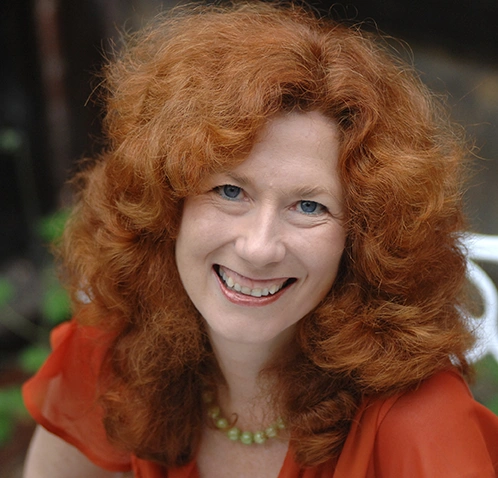
Angie Hobbs is Professor of the Public Understanding of Philosophy Emerita at the University of Sheffield. She gained a degree in Classics (First Class) and a PhD in Ancient Philosophy at the University of Cambridge, and her chief interests are in ancient philosophy and literature, and ethics and political theory from classical thought to the present, and she has published widely in these areas, including Plato and the Hero; Why Plato Matters Now was published by Bloomsbury in 2025. She contributes regularly to TV, radio, podcasts and other media around the world, including 27 appearances on In Our Time on Radio 4. She works in a number of policy sectors, including the U.K. Civil Service, National Health Service and Health Research Authority. She has spoken at the World Economic Forum at Davos, the Athens Democracy Forum, the Symi Symposium, the Houses of Parliament, the Scottish Parliament and Westminster Abbey, and been the guest on Desert Island Discs and Private Passions. She was a judge of the Man Booker International Prize 2019 and was on the World Economic Forum Global Future Council 2018-9 for Values, Ethics and Innovation.
The infamous Shakespearean line “get thee to a nunnery” conjures images of oppressed women forced into convents against their will and left to rot. But in medieval Europe, the convent could be a space of education, liberation, and authority for women, especially those who experienced mystical visions. Hildegard of Bingen derived such authority from her visions that Popes and Emperors wrote to her for advice. She even called the Holy Roman Emperor “a little boy or some madman” for his political decisions – and he apologised to her.
In this session, we explore the lives of mystics such as Hildegard, Margery Kempe, Catherine of Siena, and Marguerite Porete. Through these examples, we examine how these extraordinary women could command authority over the most powerful men of the time, as well as the fiery consequences if they got it wrong.
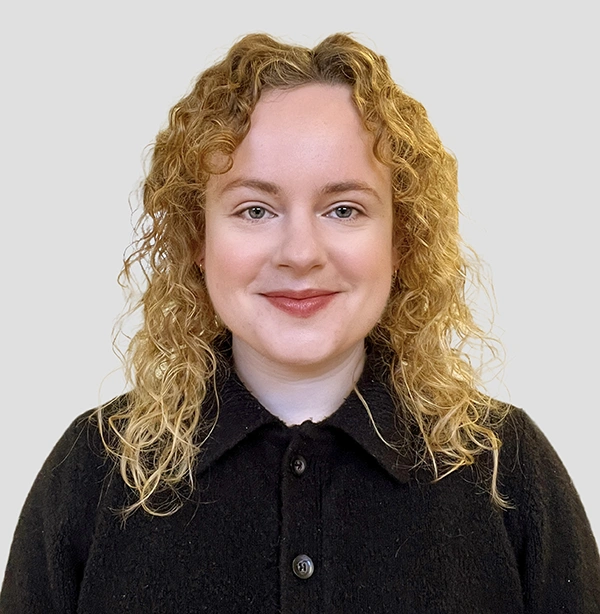
Lauren Cole is a PhD History Candidate and Presidential Fellow at Northwestern University. Her research centres on medieval mystics, medicine, and manuscripts in Europe, with a particular focus on Hildegard von Bingen. Lauren is also a public historian, creating videos on medieval history for over 95’000 followers on her Instagram and TikTok accounts (@MedievalLauren). Lauren splits her time between London, Mainz, and Chicago. You can find more on her website: https://medievallauren.wordpress.com
Our shared, two-part presentation will explore how the YAKANAL Indigenous cultural exchange program, based at Laguna Pueblo, New Mexico, United States, acts as a living bridge between Indigenous Knowledge and contemporary creative practice.
Part I of our presentation will give context of YAKANAL’s work and impact, drawing from more than twenty years of knowledge exchange among Pueblo communities of present-day New Mexico and Maya, Zapotec, and Mixtec communities of Mesoamerica. Through images, stories, and a short video, we will share how Indigenous-led cultural exchanges can provide multigenerational participants with immersive opportunities to learn and create in relationship to place.
Part II of our presentation will focus on creation stories as frameworks for balance, reciprocity, and responsibility—principles that guide sustainable creative practice for all humans, regardless of background. Indigenous knowledge systems do not simply recount stories—they articulate a “Science of Place” expressed through food sovereignty, artistic practice, traditional medicine, architecture, cosmology, beekeeping, and social organization—all embedded in the lifeways of Indigenous communities today.
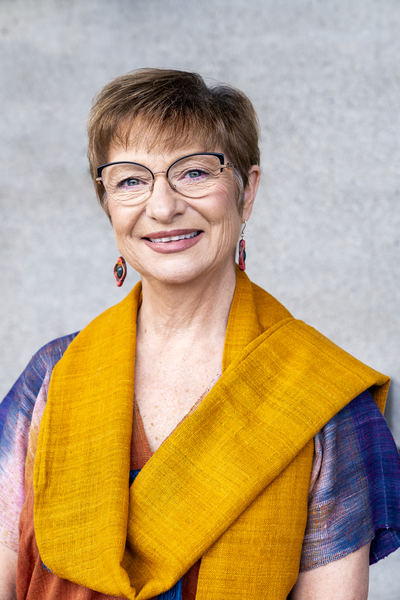
Isabel Hawkins, Senior Scientist (she/her/ella), grew up in Córdoba, Argentina, where the beauty of the night sky and a childhood visit to the Planetario charted the course of her career as an astronomer and science educator. Reaching for the stars, Isabel came to the United States as an American Field Service exchange student when she was sixteen. In 1981, she received a BS in physics from UC Riverside, where she was asked to join Phi Beta Kappa. Subsequently, she obtained an MS and a PhD in astrophysics from UCLA. Before joining the Exploratorium in 2009, she spent 20 years as an astrophysics researcher and science educator at the University of California, Berkeley, Space Sciences Laboratory. Isabel’s work at the Exploratorium is focused on NASA, NSF, and museum-funded efforts related to Latinx audience engagement, such as Solar Eclipse, GENIAL: Generating Engagement and New Initiatives for All Latinos, and Cambio, a professional development approach for building Latinx-focused cultural competence in museums. Through cultural astronomy, she fosters science pluralism by making visible The Cultural Roots of STEM (science, technology, engineering, and mathematics), a research synthesis effort that has been funded by the NSF. The Astronomical Society of the Pacific bestowed on her the prestigious Klumpke-Roberts Award in recognition of her outstanding contributions to the public understanding and appreciation of astronomy, an honor that she shares with fellow awardees Carl Sagan, Isaac Asimov, Julieta Fierro, and Tim Ferris, among others. Isabel is also a consultant for the Smithsonian Institution, a volunteer coordinator for the YAKANAL, Indigenous Youth Cultural Exchange program, and a 2018 to 2022 Fulbright US Global Scholar. Her interests include salsa and bachata dancing, yoga, drawing Maya classic period glyphs, and the study of native languages.
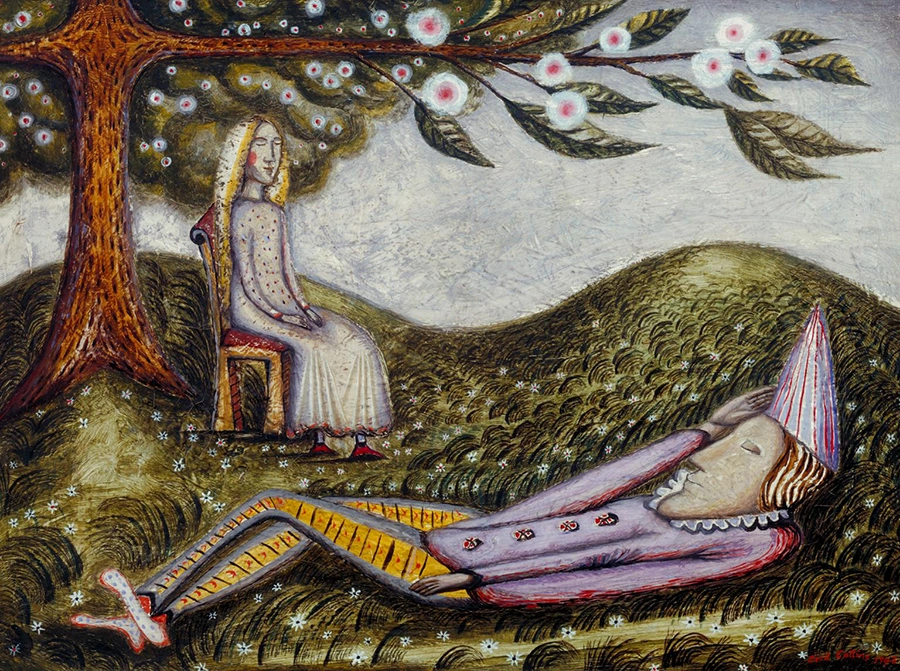
The poet, Edwin Muir, enjoyed a paradisial childhood, which, though rudely interrupted, provided a sustaining sense of innocence and wonder through which he subsequently beheld the world and wove artistic practices that sought to widen and deepen consciousness into a ‘second, renewing innocence’ that was a paradise regained.
He employed artistic, spiritual practices that deepened attention, reverenced, and used dreams and other imaginal states, and cultivated good memory to develop works of great originality and of gently transforming power that he felt could take people on a pilgrimage to their originating light, where “that strange quarry you scarcely thought you sought” would reveal itself and you would find “Yourself, the gatherer gathered, the finder found.”
Though he worked within the ‘Western tradition’, he had an openness to the Spirit that bloweth where it will, and was sustained, nurtured, and challenged in a long, loving marriage to Willa Muir, herself a writer. In his practices and his work, he has much to inspire us about the potential for a creative, spiritual life.
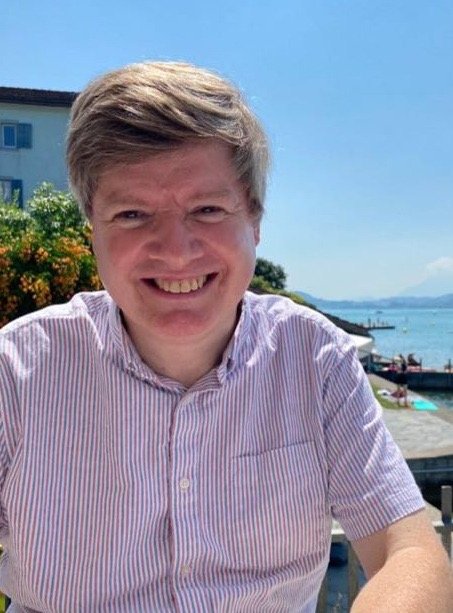
Nicholas Colloff, when not posting art on Facebook or walking through the woods, is the Director of the Argidius Foundation, a Swiss family foundation that helps develop social and environmental enterprises, principally in Africa and Latin America. He studied theology, philosophy, and the psychology of religion at university, after which he helped found the Prison Phoenix Trust that teaches meditation and yoga to people in prison, and from this discovered a gift for starting things (and leaving them in better hands so that they flourished).
This has included a microfinance bank in the Balkans, a charity focused on community mental health in poor communities in the Global South, and a social investment fund. Through the auspices of Temenos and the friendship of the poet and Blake scholar, Kathleen Raine, he was privileged to meet and know Cecil Collins in the latter years of his life, and through Kathleen to know one of Edwin and Willa Muir’s closest friends.
In 1939, as fascism arose across Europe, the German poet Bertolt Brecht asked ‘Will there be singing in the dark times?’ and responded with a ‘Yes’: ‘there will be singing about the dark times’. Similarly, in response to the Palestinian tragedy of the Nakba, Palestinian poet Mahmoud Darwish asked what poetry can say at such a time.
As global warming proceeds even faster than forecast, as the oceans warm to record temperatures, as fires break out across the Northern Hemisphere, as more humans die of heat stress, as ecological breakdown and the Sixth Extinction of living beings gather pace, both warnings from scientists and Western political cultures appear powerless to budge us from our destructive path. What can poetry say? Theodor Adorno told us that ‘To write poetry after Auschwitz is barbaric’. Is this also true today?
Facts are said to be sacred; but we need more than facts. Guardian arts correspondent Charlotte Higgins tells us that poetry is ‘the only language for these times of violence and chaos’. Canadian poet Robert Bringhurst writes of poetry as ‘stepping in tune with being, bearing and echoing the music and heartbeat of being’.
This presentation of songs and poems will reflect on different ways in which poetry and song can respond to the present climate and ecological catastrophe.
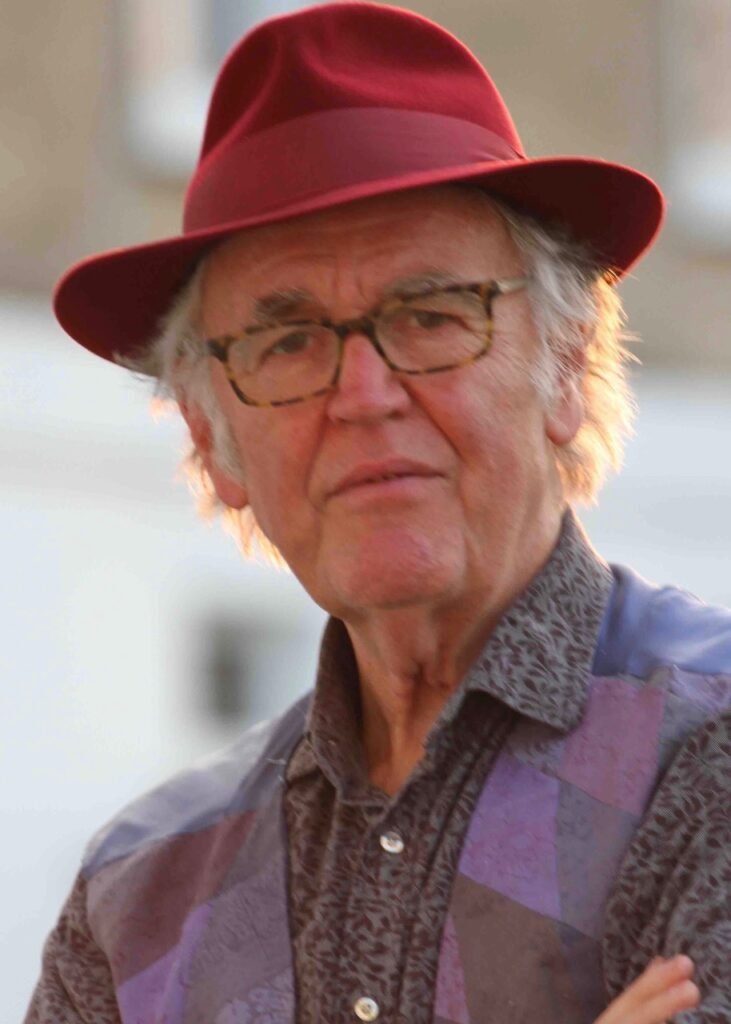
As Director of the Centre for Action Research in Professional Practice at the University of Bath, England, Peter Reason was an international leader in the development of participative approaches to action research. In these forms of experiential inquiry all are co-researchers, contributing both to the thinking that forms the research and to the action that is its subject. He published widely, co-editing the Handbook of Action Research: Participative Inquiry and Practice and co-founding the journal Action Research.
Since retiring from his academic position, Peter has focused on writing that links the tradition of nature writing with the ecological crisis of our times, drawing on scientific, ecological, philosophical and spiritual sources. He is currently engaged in a series of experiential and co-operative inquiries exploring living cosmos panpsychism in relation to Rivers. His books include Spindrift: A wilderness pilgrimage at sea; In Search of Grace: An ecological pilgrimage, and most recently (with artist Sarah Gillespie) On Presence: Essays | Drawings and On Sentience: Essays | Drawings. He is currently preparing Living in a Sentient World: An inquiry with his colleagues Freya Mathews, Andreas Weber, Stephan Harding, and Sandra Wooltorton.
Peter is Professor Emeritus at the University of Bath.
Who's coming?
68 people are attending Creation and Life Itself