
Your cart is currently empty!
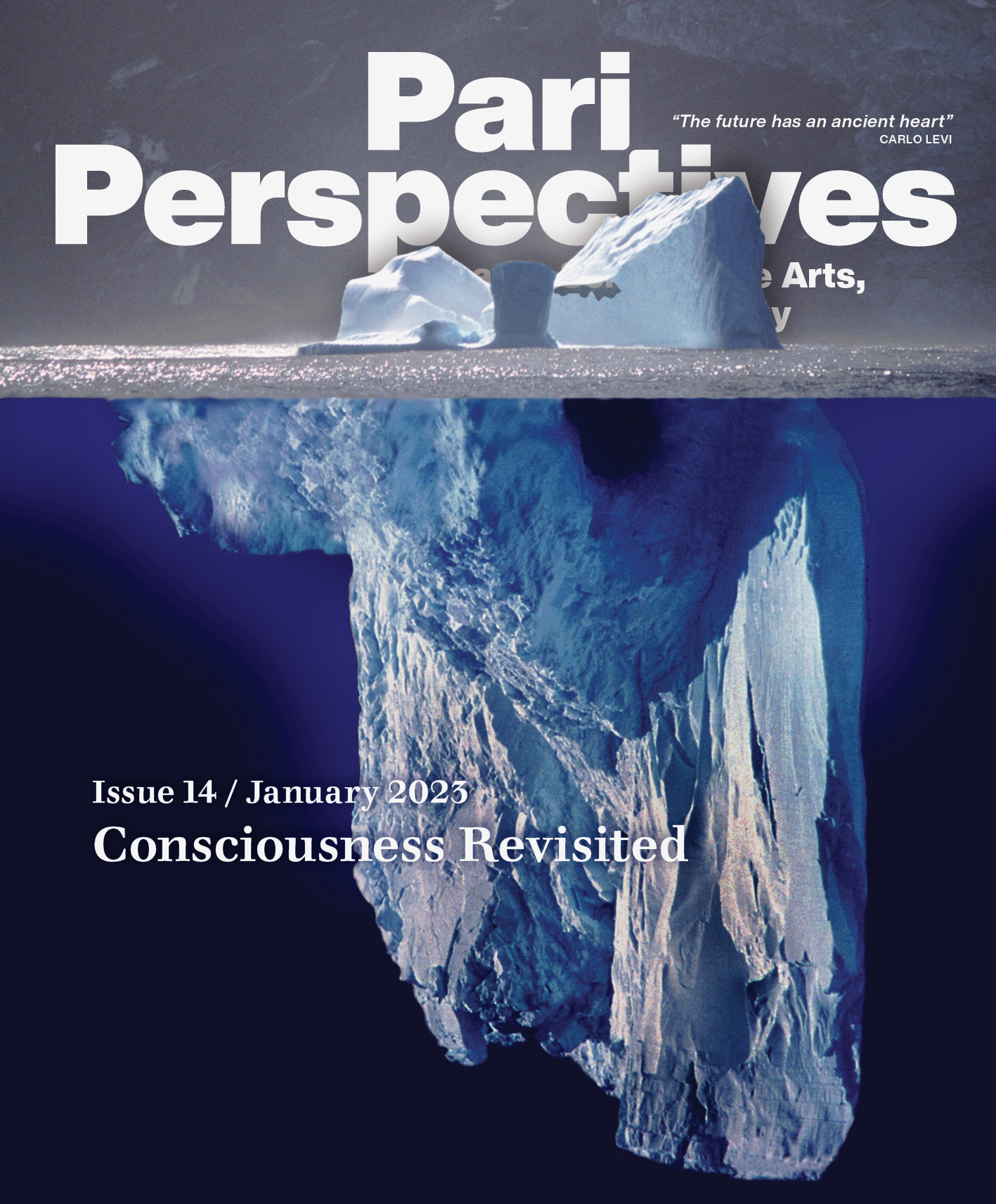
Pari Perspectives 14
January 2023
Consciousness Revisited
‘Consciousness Revisited’ is the title we have given to the current issue of Pari Perspectives, having initially probed this seemingly inexhaustible topic in December 2021. In this issue we are pleased to include both prominent names in the consciousness field and to introduce a few lesser-known contributors who nevertheless have interesting perspectives on the topic.
In ‘The Brain and Our Encounter with the World’ we have transcribed a webinar presented by psychiatrist Iain McGilchrist originally for the Pari Center community in September 2021 as part of the ‘What is Consciousness’ series. Iain discusses some of the highlights of his magnum opus The Matter With Things (a 1500-page, two-volume book in the print version) whose core argument is that we need to move from an understanding based upon the reality of matter to one based on process and flow.
In ‘Mundane and Mystical: A Panentheistic Perspective on C.G. Jung’s Late Thoughts about Consciousness, Ego, and Self’ Roderick Main, professor in the department of Psychosocial and Psychoanalytic Studies and Director of the Centre for Myth Studies at the University of Essex, closely examines Carl Jung’s mystical NDE (Near Death Experience) which occurred in 1944 and led to an overhauling of his thinking. This, too, is a transcription from the same series.
In ‘A Science of Harmony and Gentle Action’ F. David Peat writes that a new surge in science involving the study of consciousness and matter should acknowledge the existential fact of our being in the universe and should accommodate a sense of wholeness, celebration, joy and wonder at nature. It should act to heal our division from nature and from our own bodies.
A young insightful newcomer to Pari Perspectives, Wes Ettinger, examines ‘Relativity and Quantum Theory in Virginia Woolf’s The Waves’ stating that ‘in many ways both The Waves and To the Lighthouse … each portrays consciousness becoming interpenetrating and reaching beyond the boundaries of individual minds.’
In ‘Naming the Dead: The Grateful Dead. Word Coinage, Serendipity, and the Creative Process’ Alan Trist, former administrator of the Grateful Dead’s song catalogue, reveals how the Sixties group came across a fairy-tale from which they took their name. We also include poems from Richard Berengarten’s collection The Wine Cup: Twenty-Four Drinking Songs for Tao Yuanming. In seasonal celebration—for those in the northern hemisphere—we have chosen three poems with a winter theme.
Joan Walton and Todd Bureau examine the meaning of consciousness through personal stories and Mary Pearson and Paul Grof look at ‘Creative Oneness: Intuition as a Vehicle for Transformation’ a topic on which they give workshops. Intuition, they say, is finally being recognized as a powerful tool in many fields of endeavor, including science, medicine, the arts, and business. Intuition is more of a heartfelt energy than an intellectual one.
Lee Nichol in his ‘Introduction to Holoflux: Codex’ (Pari Publishing, 2022) tells us that ‘no book like this has been attempted before—to take the ostensibly abstract thought of David Bohm and render that thought into first-person, phenomenological expression through paintings, drawings, typographical experiments, impressionistic writing and philosophical exposition. Here the collective representations of a society are temporarily set aside by the deeper promptings of human consciousness.
Philosopher William Seager examines the recent surge of work in panpsychism while Natalie Lawrence looks at ‘Spontaneous Revolutions’: Darwin’s Diagrams of Plant Movement’ in which Darwin thought he had discovered something new—a phenomenon he’d never seen and described in detail.
And finally in our ‘More Perspectives’ section, philos- opher James Fox’s essay ‘Bohm, Leibniz, Blake, and the Paintings of Yana Trevail’ introduces us to the art of his wife, Yana Trevail, painter and printmaker.