• Hope and Delusion

    Online

    When we realise just how much hangs on our attitudes towards the various forms of crisis we are exposed to, we may come to see what our work really is. Hope has a curious story to tell. It reminds us of the wealth we carry within us, but also of how easily we are persuaded to give it all up. This talk attempts to string together disparate stories relating to, but not necessarily about, hope, and aims specifically to raise more questions than it answers. Accompanying the talk there will be breakout and plenary sessions in which participants will be able to articulate their thoughts and responses.

    Free
  • Analytic Idealism

    What Is Consciousness?
    Online

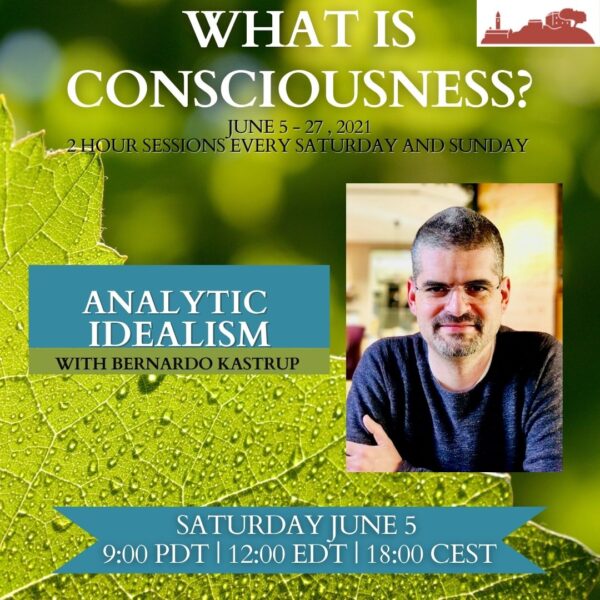
    Two widespread current notions of consciousness are physicalism, i.e. the perspective that assumes physical reality, matter, as fundamental, and bottom-up panpsychism, i.e. the perspective that takes everything as possessing mind or consciousness and higher levels of consciousness consisting of a combination of more elementary levels. Bernardo Kastrup will argue for an idealist (consciousness only) ontology consistent with empirical observations, which seeks to explain the facts of nature more parsimoniously than physicalism and bottom-up panpsychism. This ontology also attempts to offer more explanatory power than both physicalism and bottom-up panpsychism, in that it does not fall prey to either the ‘hard problem of consciousness’ (the challenge of deducing consciousness from matter) or the ‘subject combination problem,’ (the challenge of deducing higher levels of consciousness from lower levels).

    €160,00
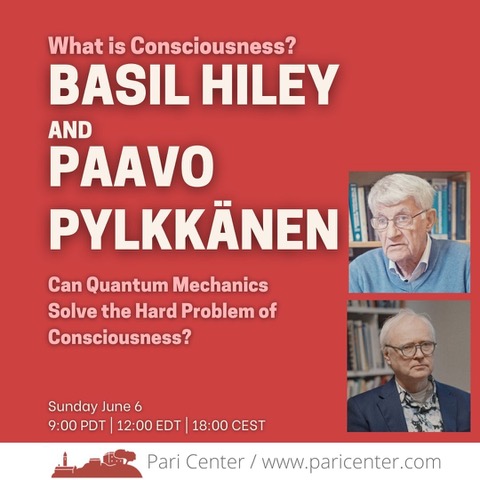
  • Can Quantum Mechanics Solve the Hard Problem of Consciousness?

    What Is Consciousness?
    Online

    The hard problem of consciousness is the problem of explaining how and why physical processes give rise to consciousness. Regardless of many attempts to solve the problem, there is still no commonly agreed solution. It is thus very likely that some radically new ideas are required if we are to make any progress. In this presentation we turn to quantum theory to find out whether it has anything to offer in our attempts to understand the place of mind and conscious experience in nature. In particular we will be focusing on the ontological interpretation of quantum theory proposed by Bohm and Hiley and its further development by Hiley and its philosophical interpretation by Pylkkanen.

    €160,00
  • Mundane and Mystical: A Panentheistic Perspective on C. G. Jung’s Late Thoughts About Consciousness, Ego, and Self

    What Is Consciousness?
    Online

    C. G. Jung insisted that there could be no consciousness without an ego, and accordingly he expressed scepticism about the desirability and even the possibility of experiencing pure consciousness or egoless awareness—a view seemingly at odds with worldwide mystical experience as well as much Asian philosophy. In his presentation Roderick will re-examine Jung’s position on this issue in light of Jung’s own mystical experiences in 1944, some late developments in his thinking about the relationship between the ego and the self, and the case for his being viewed as an implicit panentheist. He will argue that Jung’s  thought can provide a much richer and more socially relevant account of mystical experience, including of the experience of egoless awareness, than is often supposed and than some of his own comments might lead one to expect.

    €45,00
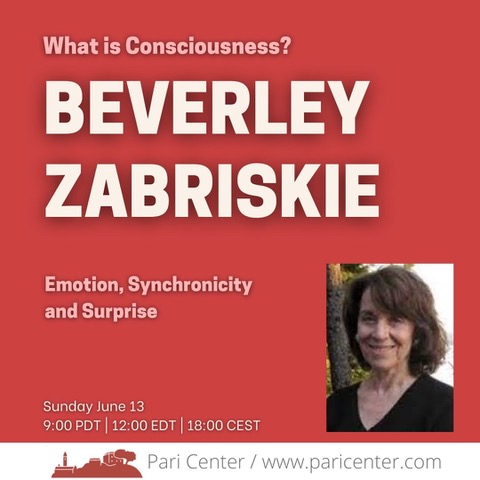
  • Emotion, Synchronicity and Surprise

    What Is Consciousness?
    Online

    This discussion will engage the intrinsic role  of emotion and the agency of imagination as catalysts of unfolding, as  intensities in the imprinting  of mind and psyche, body and  brain. The necessity of surprise as a basic survival emotion, and a crucial component of psychic process will be highlighted.

    We will hear implicit and explicit resonances between Jung’s tenets and four contemporary theorists’ relevance to our understanding of  inter-relatedness, on the continuum of emotion, synchronicity and surprise

    €160,00
  • The Ancestors—the Tree of Life and Intergenerational Patterning

    Online

    This talk will focus on the unconscious patterns which run through families and generations of families, as one generation inherits, responds and reacts to the complexes and archetypal energies of the previous generation—and even of the generation before that—parents, grandparents and in some cases, great-grandparents. Drawing on mythology and other cultural experiences, the presenter will explore the symbolic nature of the genogram, or psychological genealogy tree, and its connection to the Tree of Life as a visual image for eliciting, revealing and deepening insights into family and ancestral patterning.

    Free
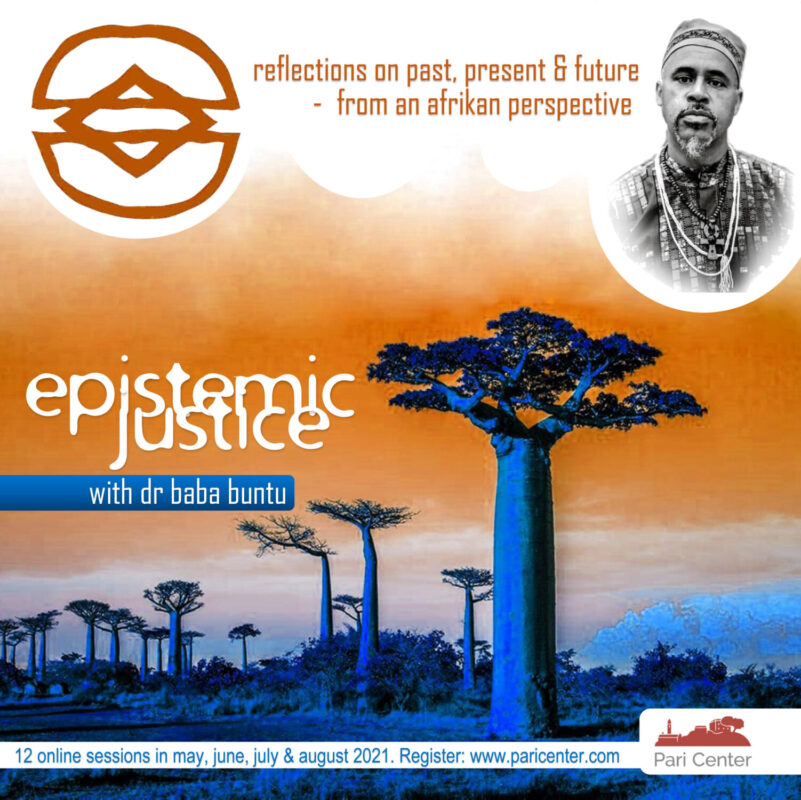
  • Epistemic Justice

    Online

    This seminar-series is a presentation of reflections on justice, liberation and transformation. It is a fragmented story, inspired by the presenter’s tri-continental life-journey, interpreted through a trans-disciplinary lens and motivated by finding strategies for change through epistemic disobedience.

    €30,00
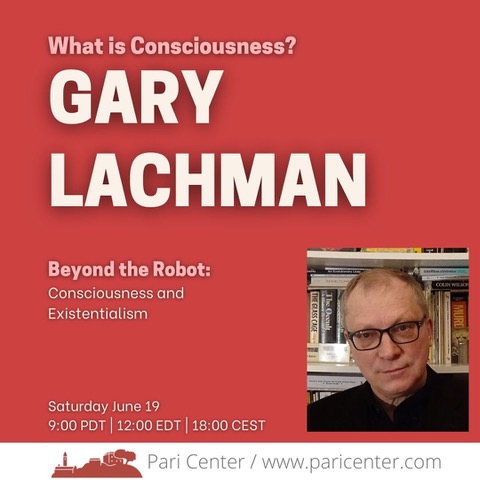
  • Beyond the Robot: Consciousness and Existentialism

    What Is Consciousness?
    Online

    Lachman will base his presentation on the work of Colin Wilson and his ‘new existentialism,’ a phenomenological analysis of the habits that keep us from experiencing consciousness as we should (that would be more along the lines of Maslow’s ‘peak experience’), the ‘dampers’ we unconsciously place over our perceptions that can lead to depression, angst, and existential despair. This ‘muffling’ of experience is the result of a necessary editing process, that allows us to maneuver through life successfully.

    €160,00
  • What Is the Neural Correlate of Consciousness?

    What Is Consciousness?
    Online

    This presentation will discuss some of the complexities in understanding what exactly a conscious experience is, as different groups (philosophers and physicians, for example) describe it very differently. We will then look at the multitude of suggestions for the NCC and try to draw some conclusions about what the NCC could be based on these ideas. We will also explore the reasons some scholars believe that trying to identify the NCC is a fool’s errand and whether these reasons make sense from a scientific point of view.  Finally, we will examine the “embodied cognition” movement can shed some light on these issues.

    €160,00
  • The Inner Science, Experiential Investigation, and Analysis of Consciousness

    What Is Consciousness?
    Online

    To practice Zen means to observe the fact and process of knowing. Consciousness is the most visible face of our mutualized knowing, a knowing through others and within the proximal spectrum of phenomenality. To closely and dispassionately observe the activity and functioning of consciousness, it is necessary, additionally, to actualize a transformational ‘awareness-observing-consciousness.’ This is a shift in kind: a shift from a self- referencing, comparative consciousness to a non-self- referencing, non-comparative awareness.

    €160,00