
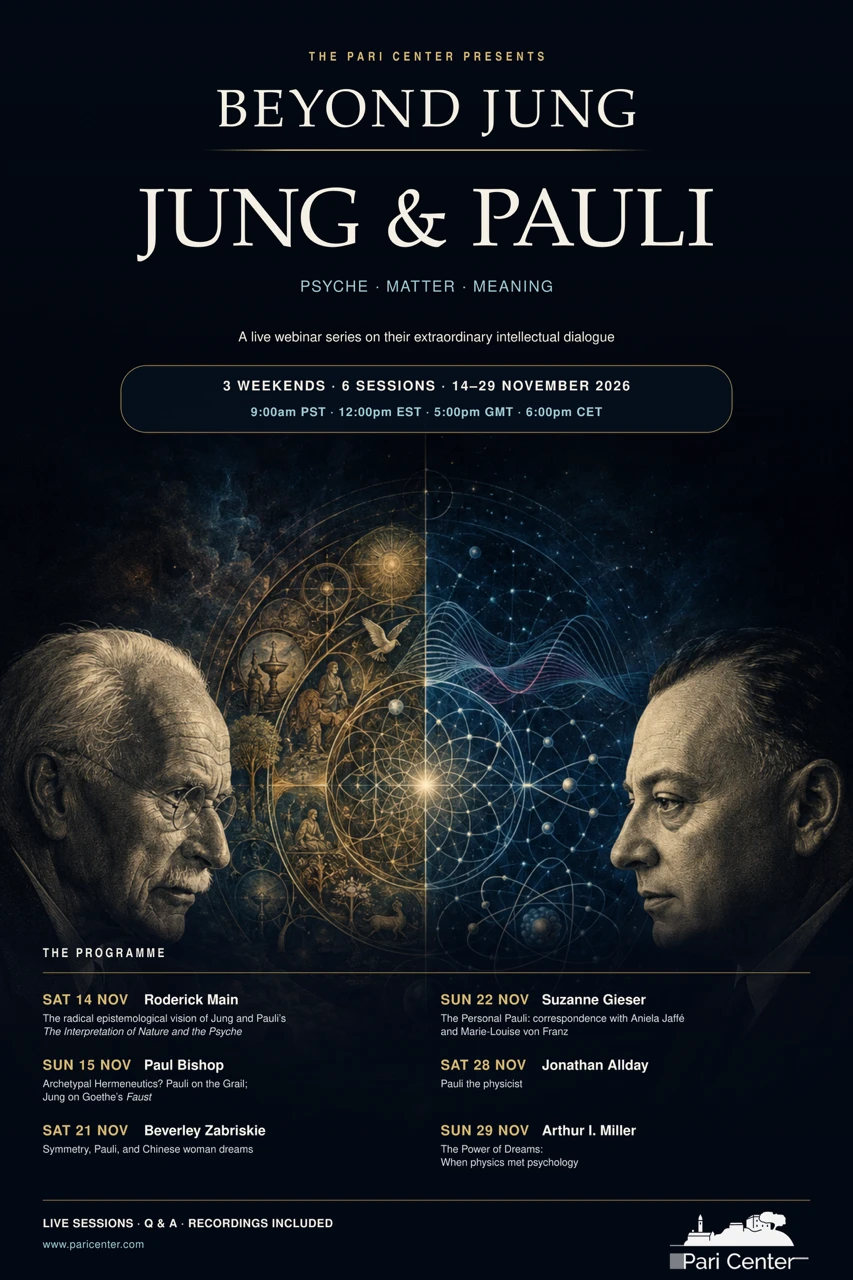
Beyond Jung: Jung and Pauli
Psyche, Matter, Meaning
14–29 November 2026
9:00 am PST | 12:00 pm EST | 5:00 pm GMT | 6:00 pm CET
A six-part online series over three weekends exploring the remarkable encounter between C.G. Jung and Wolfgang Pauli, and their shared search for a deeper understanding of psyche, matter and meaning.
With Jonathan Allday, Paul Bishop, Suzanne Gieser, Roderick Main, Arthur I. Miller, Beverley Zabriskie
Each session is two hours. All registered participants will receive access to the recordings, so you can attend live or watch at a time convenient to you.
What happens when one of the twentieth century’s most influential psychologists enters into a sustained dialogue with one of its great physicists?
Few intellectual encounters of the twentieth century were as unlikely—or as fertile—as the extraordinary dialogue between the pioneering psychologist C. G. Jung and the Nobel Prize-winning physicist Wolfgang Pauli. Together they ventured beyond the conventional boundaries of their respective disciplines to explore the deeper relationship between psyche and matter, the role of the observer, the significance of dreams and symbols, and the possibility of an underlying reality from which mind and world emerge.
Across three weekends and six live sessions, Beyond Jung: Jung and Pauli brings together leading scholars to examine the radical vision of their joint work, their engagement with myth, alchemy and interpretation, Pauli’s dreams and personal correspondence, and the revolutionary physics that shaped his thought. In doing so, the series asks what their remarkable collaboration can still teach us about knowledge, meaning and our place within reality.
Programme
- Saturday November 14, 2026
The Radical Epistemological Vision of Jung and Pauli’s The Interpretation of Nature and the Psyche
with Roderick Main - Sunday November 15, 2026
Archetypal Hermeneutics? Wolfgang Pauli on the Grail, C.G. Jung on Goethe’s Faust
with Paul Bishop - Saturday November 21, 2026
Symmetry: Pauli, and Chinese Woman Dreams
with Beverley Zabriskie - Sunday November 22, 2026
The Personal Pauli: Topics in the Correspondence with Aniela Jaffé and Marie-Louise von Franz
with Suzanne Gieser - Saturday November 28, 2026
Pauli the Physicist
with Jonathan Allday - Sunday November 29, 2026
The Power of Dreams: When Physics Met Psychology
with Arthur I. Miller
Sessions
Click on a session below to expand
Saturday November 14, 2026
9:00 am PST | 12:00 pm EST | 5:00 pm GMT | 6:00 pm CET
This session is two hours. All registered participants will receive access to the recordings, so you can attend live or watch at a time convenient to you.
In this talk, I shall offer a reading of Jung and Pauli’s joint book, The Interpretation of Nature and the Psyche (1952/1955), focusing on the fundamental problem both thinkers were attempting to address: the rationalistic one-sidedness of modern science with its perilous psychological, social, cultural, and environmental consequences. I shall highlight how, in response to this problem, each of the two essays in the book—Jung’s Synchronicity: An Acausal Connecting Principle and Pauli’s The Influence of Archetypal Ideas in the Scientific Theories of Kepler—offers a radically expanded, holistic vision of the origin, nature, and scope of knowledge. I shall show that this epistemological vision also has implications for ontology, methodology, and ethics, that is, for how we might understand reality, pursue science and scholarship, and relate to one another, nature, and our ultimate concerns. Throughout, I shall draw attention to how the two essays interrelate, support each other, and together make a richer and more compelling case than either essay makes individually. Finally, I shall assess the extent to which the radically different way of doing science and scholarship that emerges from the essays is exemplified by the essays themselves.

Roderick Main, PhD, works at the University of Essex, UK, where he is Professor in the Department of Psychosocial and Psychoanalytic Studies and Director of the Centre for Myth Studies. His books include The Rupture of Time: Synchronicity and Jung’s Critique of Modern Western Culture(Brunner-Routledge, 2004), Revelations of Chance: Synchronicity as Spiritual Experience (SUNY, 2007), and Breaking the Spell of Disenchantment: Mystery, Meaning, and Metaphysics in the Work of C.G. Jung (Chiron Publications, 2022).
Sunday November 15, 2026
9:00 am PST | 12:00 pm EST | 5:00 pm GMT | 6:00 pm CET
This session is two hours. All registered participants will receive access to the recordings, so you can attend live or watch at a time convenient to you.
In many ways, the twentieth century was the century of interpretation—or, to give it its technical name, hermeneutics. This paper will examine the question of interpretation for Wolfgang Pauli and C.G. Jung alike, discussing (a) Pauli’s interest in the Grail myth as reflected in his correspondence with Emma Jung and (b) Jung’s interpretation of Pauli’s dreams in relation to his own pursuit of alchemical themes in Goethe’s Faust. The paper will invite participants to consider the following question: What is the role of hermeneutics or interpretation in our own quest for meaning?

Paul Bishop is Honorary Professorial Research Fellow in the School of Modern Languages and Cultures at the University of Glasgow, UK. He is interested in all aspects of German culture and thought, in tracing the progression of ideas through time, and in uncovering links between German culture and the concepts of analytical psychology. He is the author of various studies on aspects of Jung’s thought in an intellectual-historical perspective, and he is currently working on a four-volume project (published by Chiron), Jung and the Epic of Transformation.
Saturday November 21, 2026
9:00 am PST | 12:00 pm EST | 5:00 pm GMT | 6:00 pm CET
This session is two hours. All registered participants will receive access to the recordings, so you can attend live or watch at a time convenient to you.
Two intellectual giants, the Nobel Laureate quantum physicist Wolfgang Pauli, although 25 years younger, and the Swiss psychiatrist and analyst, C.G. Jung, exchanged thoughts and feelings about the nature of realities through vibrant letters and their thesis of synchronicity. In their view, a human observance could grant significance, not of cause and consequence, but of correlates and correspondences. When imprinted by emotion, elaborated by imagination, and consolidated by memory, the human capacity for reflection thus created an experience of psyche in the material world.
From their respective poles, Jung’s from the inside-out, and Pauli’s from the outside-in, these men and their collaboration continue to transgress categories and alter our species’ framing of the human position, in space and time, whether held as basic properties, mental constructs or crucial factors of existence.
Each man was transgressive, not bound by the constructs in their fields. Their stretch and grasp crossed false frontiers through their overlapping interests in the underlying patterns in the impersonal and subjective natures of reality. Pauli shared Jung’s perception of an unconscious reality as well as the external, a space he termed ‘a kind of secret laboratory beyond human consciousness.’ (Pauli to Fierz, October 3, 1951, von Meyenn 1996, p. 377). Each of course had limitations. In his science, and hence in self, Pauli insisted on symmetry as fundamental in the physical world. But in the ‘secret laboratory’ his dreams of a dancing and spinning Chinese woman may be seen as his unconscious, internal effort to wrest him from a concept being proven unscientific in favour of symmetry-breaking, allowing a separation of the mental and physical worlds. They may also have prepared him for illness and death. We will evoke his dream imagery as metaphor and reality, addressing both renewal of theory and internal transformation.

Beverley Zabriskie, L.C.S.W. is a Certified Jungian Analyst in New York City, a founding faculty member and former President of the Jungian Psychoanalytic Association (JPA), and past Vice President of the Philemon Foundation which produces the unpublished writings of Jung. Her publications include ‘A Meeting of Rare Minds,’ the Preface to Atom and Archetype. The Pauli-Jung Correspondence, Princeton Press, 2001; ‘Time and Tao in Synchronicity’ in The Pauli-Jung Conjecture and Its Impact Today (2014); ‘Psychic energy and synchronicity,’ Journal of Analytical Psychology, (April 2014).
Sunday November 22, 2026
9:00 am PST | 12:00 pm EST | 5:00 pm GMT | 6:00 pm CET
This session is two hours. All registered participants will receive access to the recordings, so you can attend live or watch at a time convenient to you.
Suzanne Gieser, PhD, holds a doctorate in the History of Science, with a specialization in the history of psychiatry and psychotherapy, and is also a licensed psychotherapist specializing in trauma treatment and clinical supervision. She works both in private practice and as a clinician at a specialist clinic for survivors of sexual trauma. She has studied the psychology of C.G. Jung since 1981, with a particular focus on the intellectual relationship between Jung and the physicist Wolfgang Pauli. Her book, The Innermost Kernel: Depth Psychology and Quantum Physics. Wolfgang Pauli’s Dialogue with C.G. Jung, was published in English in 2005.

Suzanne Gieser served for ten years as Senior Lecturer and Associate Professor at the Institute of Analytical Psychology (IAP), a private institute for Jungian scholarly studies in Stockholm. She is a board member of the Swedish C.G. Jung Foundation and a co-founder of the Swedish Association for Imago Relationship Therapy. She is also the editor of C.G. Jung’s 1937 and 1938 seminars held in Bailey Island and New York, published in 2019 and has recently published an essay on Synchronicity (in Swedish) in an Anthology on recent research on Consciousness and so-called paranormal phenomena.
Saturday November 28, 2026
9:00 am PST | 12:00 pm EST | 5:00 pm GMT | 6:00 pm CET
This session is two hours. All registered participants will receive access to the recordings, so you can attend live or watch at a time convenient to you.
An accessible introduction to the physics of Wolfgang Pauli, his contributions to the subject and a little about Pauli the man.
Sunday November 29, 2026
9:00 am PST | 12:00 pm EST | 5:00 pm GMT | 6:00 pm CET
This session is two hours. All registered participants will receive access to the recordings, so you can attend live or watch at a time convenient to you.
Most physicists are adamant that they don’t make discoveries while dreaming. Wolfgang Pauli was different because from Carl Jung he learned the power of dreams. This enabled him to discover CPT symmetry, a higher form of mirror symmetry, a key factor in Jung’s work. Pauli and Jung believed that physics and psychology were mirror images. I will develop Pauli’s important discovery and more.

Arthur I. Miller is Emeritus Professor of History and Philosophy of Science at University College London and holds a PhD in physics from MIT. His work explores creativity and the intersections of science, art and psychology, with a particular interest in the great scientific and intellectual developments of the twentieth century.
He is the author of numerous acclaimed books, including 137: Jung, Pauli, and the Pursuit of a Scientific Obsession, which explores the remarkable relationship between physicist Wolfgang Pauli and psychologist Carl Jung and the ways their exchange of ideas influenced their thinking about psyche, matter, number and synchronicity. His other books include Einstein, Picasso: Space, Time and the Beauty That Causes Havoc, Empire of the Stars, Colliding Worlds: How Cutting-Edge Science is Redefining Contemporary Art, and The Artist in the Machine: The World of AI-Powered Creativity.
Miller has lectured internationally and written extensively on the history and philosophy of modern science, scientific creativity, the relationship between art and science, and artificial intelligence.