• Science, Philosophy, Evidence, Explanation and Fine-Tuning

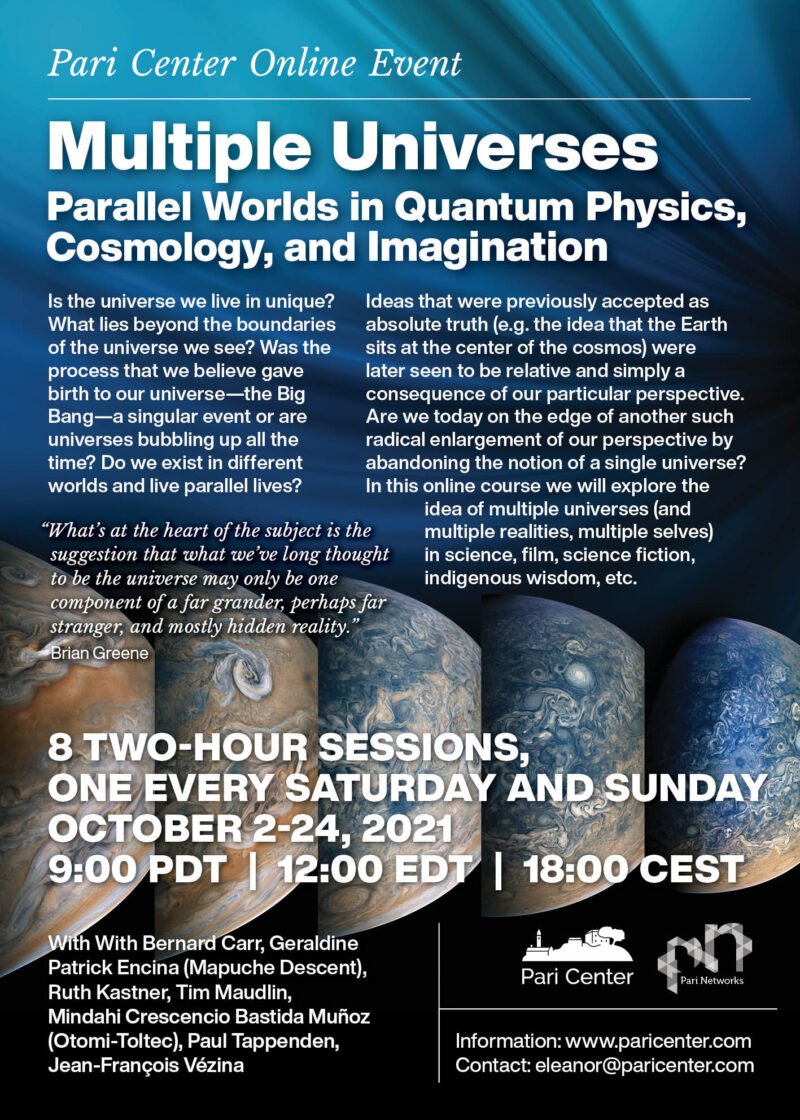
    Multiple Universes
    Online

    Various sorts of “multiverse” scenario force us to reflect both on the aims of physics and on the sorts of considerations that can make a theory credible. This topic has been somewhat suppressed in the physics community by the prevalence of operationist and instrumentalist rhetoric (“Shut Up And Calculate”). I will survey the situation with respect to how multiverse theories could address fine-tuning problems, and the challenges that remain in making the principles used for assessing credibility clear and explicit.

    €18,00
  • Imagined Problems: Real Opportunities

    Online

    The science of perception tells us that our problems are subjective and socially constructed. So what is a “real” problem, and what solutions become available to us?  In this engaging session, Drs. Susanna Wu-Pong Calvert, MAPP, PhD and Gary Goldberg, MD discuss the nature of perception and “reality” in our VUCA world (volatile, uncertain, complex, and ambiguous). They will also discuss how to move from feelings of overwhelm and despair to inspiration and agency by accessing our deep, inner wisdom. Joseph Campbell’s Hero’s Journey will be presented as a timeless, increasingly relevant, and useful frame for our individual and collective pursuit of meaning and authentic, impactful action, especially in light of our modern challenges.

    Free
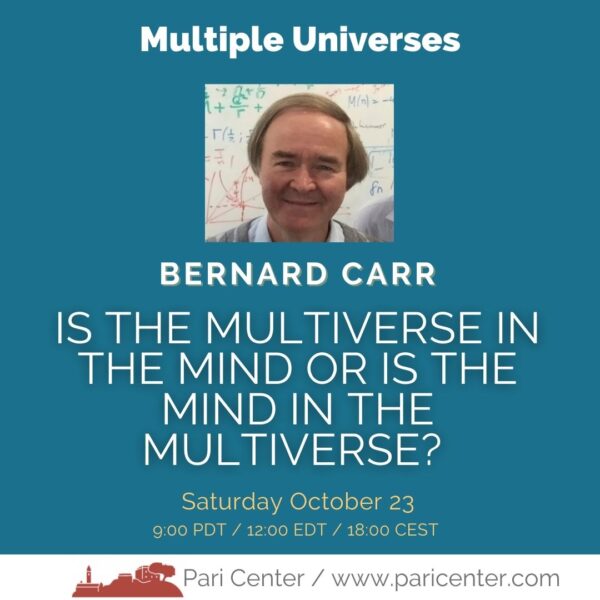
  • Is the Multiverse in the Mind or is the Mind in the Multiverse?

    Multiple Universes
    Online

    Physics has been triumphant in understanding the vast array of structures in the universe and the forces which link the microscopic and macroscopic domains. This link culminates in the big bang, where the very small (M-theory) meets the very large (the multiverse). The history of physics might also be regarded as the expansion of our consciousness to ever larger and smaller scales. However, at each stage the micro and macro frontiers have been regarded as bordering on philosophy because of the lack of empirical data. So does the merging of the two physics/philosophy borders at the big bang indicate the end of physics or the need for a radically new paradigm. I take the latter view and argue that a feature of the next paradigm must be an expansion of physics to accommodate mind and consciousness.

    €120,00
  • Closing Panel: Multiple Universes

    Multiple Universes
    Online

    A panel discussion with some of the speakers of the Multiple Universes series will close the event, reflecting on the various perspectives that have emerged in the presentations and comparing different world views.

    The session will begin by posing the panelists a few key questions to start the discussion. It will continue as a Q&A session open to everybody. You are invited to have your questions and comments ready, and in formulating them please be mindful of other people’s need to ask their own questions! The best questions are often the most concise ones.

    €18,00
  • The Consciousness of Neuroscience

    The scientific study of consciousness used to be taboo just a few decades ago, but it is now in its heyday. Consciousness research captures the imagination of laypeople, attracts research funding, and sells books. Amongst neuroscientists, the dominant position is this: whatever consciousness is, it must somehow emerge somewhere in the brain. Where else could it be? The challenge then is to find out how subjective experience springs from neural activity. But does it? By what kind of modern alchemy is the water of the matter supposed to be transformed into the wine of experience? We are never told. Instead, materialism excels at selling old metaphysical commitments as new scientific data. In addition, materialism is promissory by necessity: the grand resolution is at hand but always lies ahead – the best is yet to come.

    Free
  • The Future Scientist – A Conversation with Dr. Iain McGilchrist

    The Future Scientist – A Conversation Series
    Online

    Some likely topics that may emerge in this first conversation involve (i) the need of synthesis in the face of piles of analytic studies, (ii) the pursuit of convergence from different lines of inquiry (such as neurology, philosophy, and physics), and (iii) the constraints, both challenges and opportunities, of doing research with and without current academia.

    €5,00
  • Musical Borrowing: Theft or Tribute?

    The Quintessence of Music
    Online

    The practice of appropriating a musical phrase, a motivic idea, a concept, or even an entire melodic line as material for a “new” musical composition is as old as music itself. Composers from Johann Sebastian Bach (and before) to the present day have mined hymns, folk music, the clickety-claque of train trucks on the rails, and the work of other composers (who may have borrowed from others themselves!) in the process of creating their own sonatas, cantatas, symphonies, and suites.

    Free