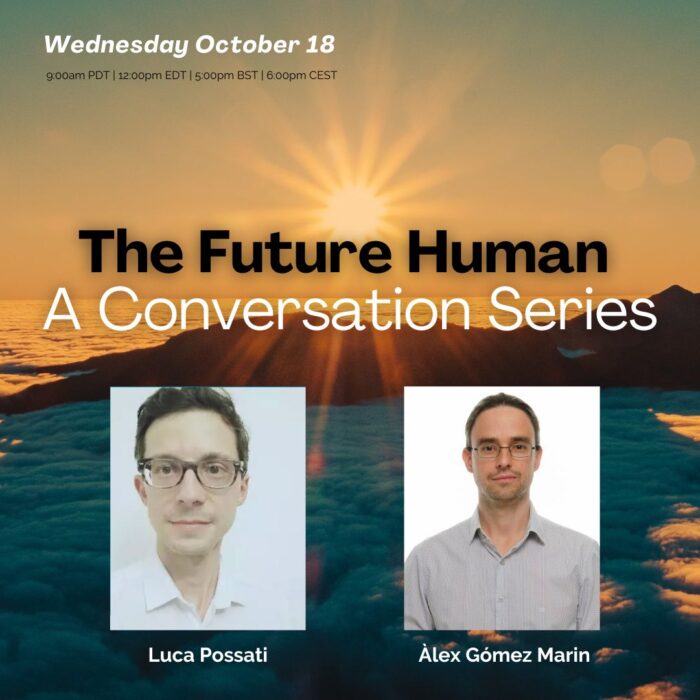
The Future Human – A Conversation with Luca Possati
OnlineThe tenth conversation in this series will be on Wednesday October 18, 2023 with Luca Possati. Our conversation will orbit around “AI and psychoanalysis”.
The tenth conversation in this series will be on Wednesday October 18, 2023 with Luca Possati. Our conversation will orbit around “AI and psychoanalysis”.

In this online series we will revisit Galileo’s book, The Assayer, on the occasion of the 400th anniversary of its publication this very month of October.
Written as a letter in a controversy about the nature of comets, such a foundational text in the history of modern science deserves to be more widely known and read. It contains one of the first and clearest articulations of the scientific method, the famous claim about the mathematical intelligibility of nature, and Galileo’s emphasis on epistemic humility in the face of dogma and authority. Remarkably, in the book we also find Galileo’s programmatic exclusion of consciousness from the purview of science, whose consequences we are still wrestling with today.
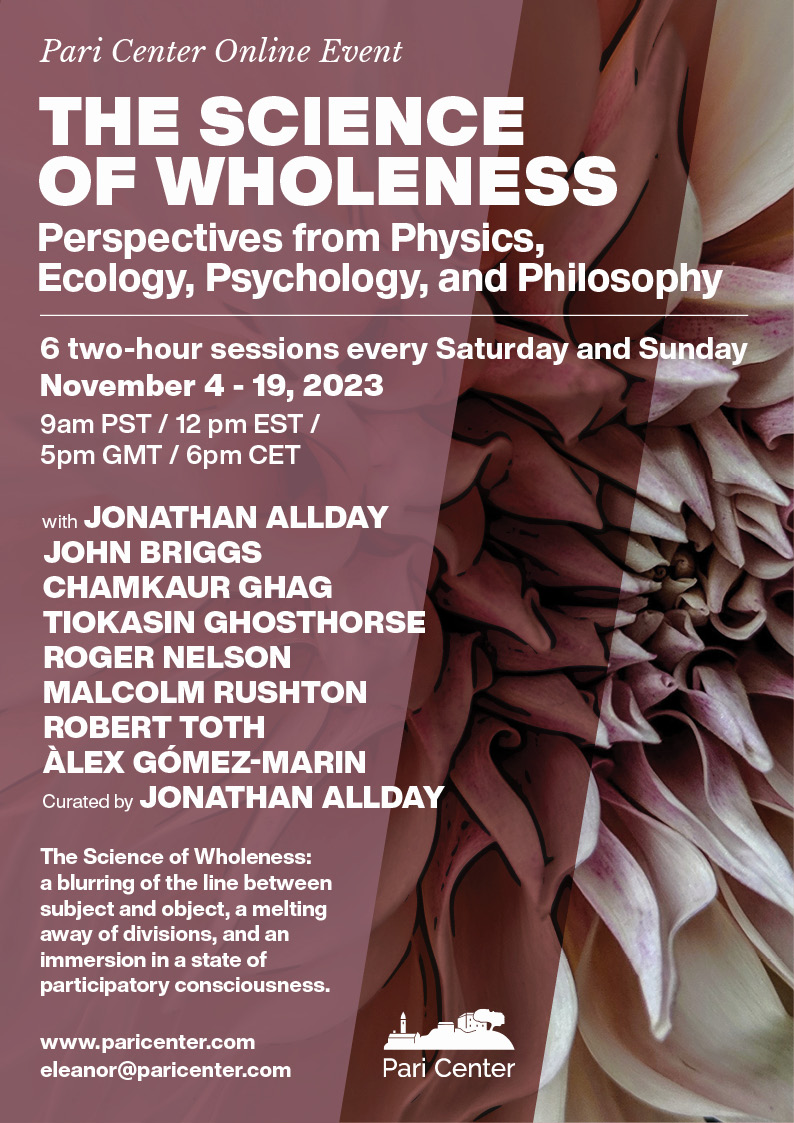
Across the broad span of wisdom traditions, one encounter is of key significance: some direct access or contact with the ground of being.
Even in this secular age, dominated as we are by the materialistic, reductionist paradigm of western science, these transcendent experiences still occur, even amongst members of the scientific community.
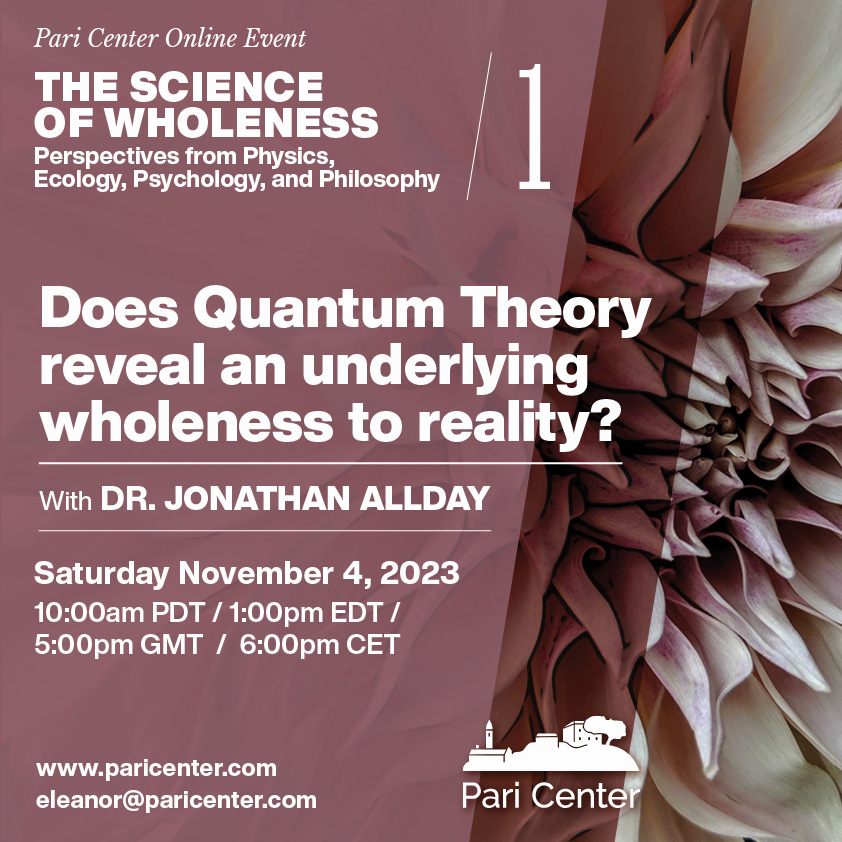
In the 1970s, a series of books, such as The Tao of Physics and The Dancing Wu Li Masters, explored the supposed synergies between quantum theory and the wisdom traditions. These well-meaning books spawned something of an industry and associated quantum hype where quantum theory was portrayed as supporting, or worse justifying, certain worldviews.
Typically, these approaches drew on the Copenhagen interpretation, the idea that the mind causes quantum state collapse and the physics of entanglement and related them to the experience of non-duality, wholeness and immersion in a universal mind characteristic of spiritual insight.
The Global Consciousness Project (GCP) is a long-term experiment using a world-spanning network of physical random number generators to collect data continuously, 24/7, since 1998. We have recorded parallel sequences of data from the network, consisting of trials of 200 bits recorded each second at each node and sent to archiving servers in Princeton, NJ. A formal experiment ran for 17 years and comprised 500 replications of fully specified and pre-registered event analyses. These tested a general hypothesis that engaging events of deep interest to large numbers of people around the world would correspond to departures of the random data from expectation.

Most neuroscientists are convinced that minds live in skull confinement — after all, their metaphysical gospel (cloaked in brain scans) insists that minds are “nothing but” what brains do. Some occasionally let their minds stroll within the body, acknowledging the importance of heart and gut, while maintaining the brain as organ king. A few conservative radicals go further and claim that minds can also protract into the world, much like the blind’s cane or everyone’s phone. Such an “extended mind” is seriously meant but often so rather metaphorically as a heterodox way to lessen the duality by spreading “mind” like butter in the bread of “matter”. I wonder if that’s sufficient, or even necessary. We are still struggling with Descartes’ forced divorce between “res cogitans” and “res extensa”; extended stuff can’t think and thinking stuff can’t enjoy extension.
Traditional Indigenous people the world over regularly employ a holistic mode of consciousness that affirms they are inseparable from the natural world. Their lives are guided by this mode. The holocentric mode is a natural feature of all human consciousness but has been suppressed in the last few thousand years by the rise of cultures organized from a second ancient mode of consciousness: the anthropocentric or human-centered mode.
Anthropocentric consciousness, which derives from perceptions that the world is made of separate things dominates the way most people living today perceive reality. By contrast, holocentric consciousness focuses on the world as a source of unity, relationships, and beauty. The holocentric mode of consciousness continues to function as a “ground state consciousness” for traditional Indigenous people and, in a different context, for creative artists.

We will explore the relationship between apparent dichotomoies through which we perceive our universe and place within it. From wave particle duality, to the left and right hemispheres of the brain, to the Quantum Field Theory and General Relativity divide that plays out in the quest to understand Dark Matter, it is becoming ever clearer that the way forward is to evolve past subjective/objective divides and come recognise the Universe as process.
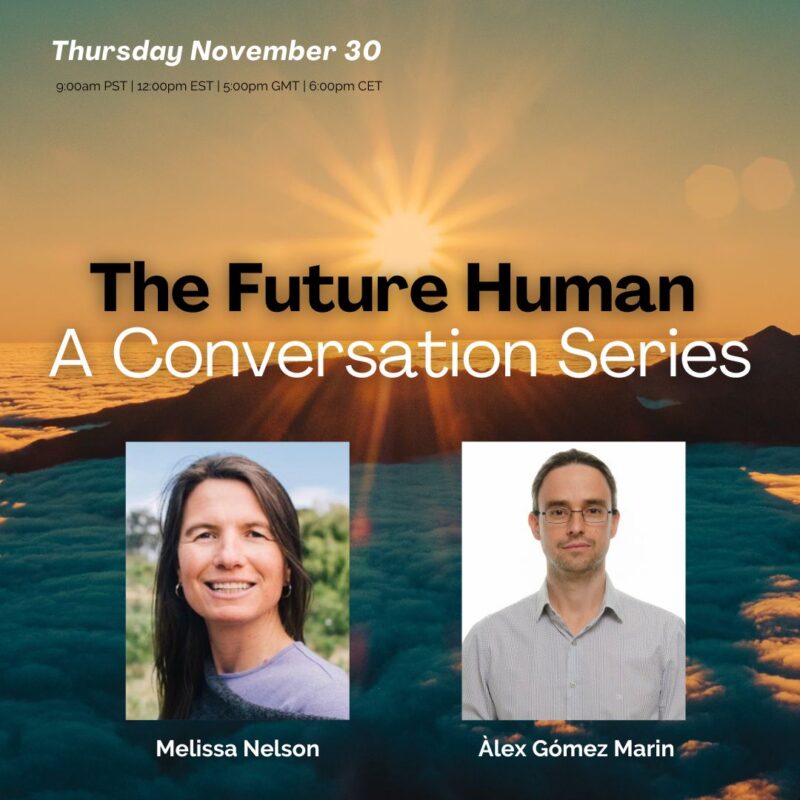
The eleventh conversation in this series will be on Thursday November 30, 2023 with Melissa Nelson. Our conversation will orbit around “Indigenous ways of knowing”.
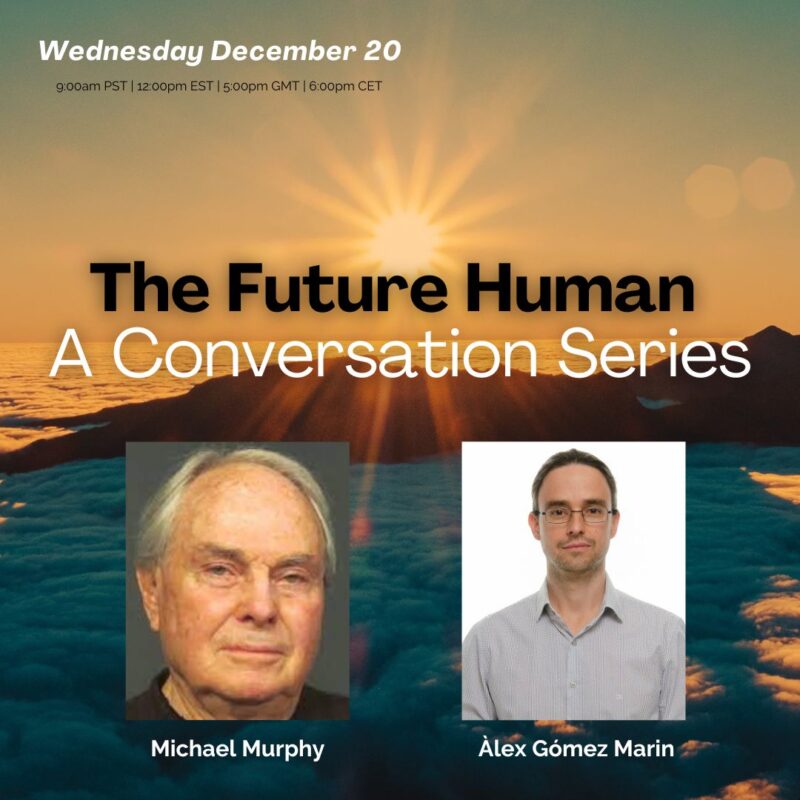
The twelfth conversation in this series will be on Wednesday December 20, 2023 with Michael Murphy.