
A Field for the Future
Celebrating the 10th Anniversary of the “Manifesto for a Post-Materialist Science”
with Karalee Kothe, Lisa Miller, Lorne Schussel, Gary E. Schwartz, Laurel Waterman, Marjorie Woollacott
Free

Celebrating the 10th Anniversary of the “Manifesto for a Post-Materialist Science”
with Karalee Kothe, Lisa Miller, Lorne Schussel, Gary E. Schwartz, Laurel Waterman, Marjorie Woollacott
Recent activities in virtually all fields engaged in consciousness studies indicate early signs of a structural turn, where verbal descriptions or simple formalizations of conscious experiences are replaced by structural tools, most notably mathematical spaces and mathematical structures. This might, on my view, lead to a novel phase in consciousness science that fundamentally changes how we engage in, theorize about, and empirically investigate conscious experiences.
Integrated Information Theory (IIT) aims to account for consciousness in physical terms by identifying the essential properties of experience (axioms), and inferring the necessary and sufficient properties that its physical substrate must satisfy (postulates). In this talk I will present an outline of IIT 4.0’s account of some qualitative contents of experience.
Christof Koch, PhD, is best known for his work exploring the physical basis of consciousness in humans, animals, and machines. A physicist and neurobiologist, he was for more than a quarter of a century a professor of biology and engineering at the California Institute of Technology in Pasadena and the president and chief scientist of the Allen Institute for Brain Science in Seattle.
Steppenwolf, by Herman Hesse. Hosts: David Schrum and Caroline Pawluk
An informal monthly get-together to discuss books of significance for the Pari Center community.
A monthly virtual encounter to reckon whence and whither humanity. Pim van Lommel, M.D., born in 1943, graduated in 1971 at the University of Utrecht, and finished his specialization in cardiology in 1976. He worked from 1977-2003 as a cardiologist in Hospital Rijnstate, a 800-bed Teaching Hospital in Arnhem, the Netherlands, and is now doing full-time research on the mind-brain relation. He published several articles on cardiology, but since he started his research on near-death experiences (NDE) in survivors of cardiac arrest in 1986 he is the author of over 20 articles (most of them in Dutch), one book and many chapters about NDE. He was co-founder of the Dutch IANDS in 1988.
The Passion of the Western Mind: Understanding the Ideas That Have Shaped Our World View
by Richard Tarnas
Hosts: David Lorimer with Guest and Author Richard Tarnas
An informal monthly get-together to discuss books of significance for the Pari Center community.
Carlos Eire is a historian of late medieval and early modern Europe at Yale University who focuses on the Protestant and Catholic Reformations; the history of popular piety; the history of the supernatural, and the history of death.
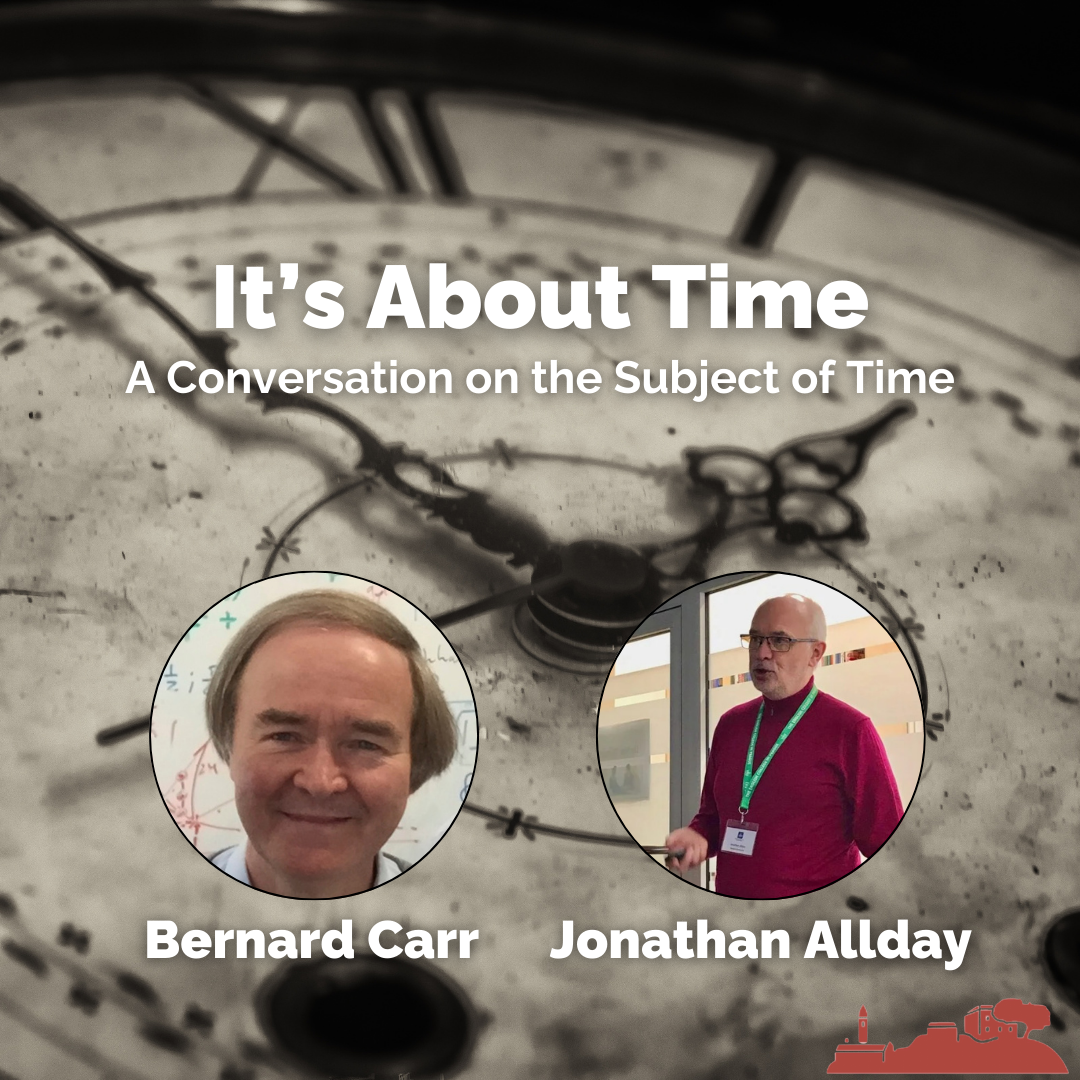
We understand how the passage of time ‘expands’ or ‘contracts’ depending on how fast you are travelling compared to an observer. There is also conclusive evidence that time distorts in the presence of mass, leading to the effects we used to ascribe to a force of gravity. Some even believe that they understand how time morphs into existence, along with the universe, out of some quantum pre-stuff. This, however, is all ‘physical time’; the relationship between the physics and the experience of ‘psychological time’ is far from clear.
The Anomaly
by Hervé Le Tellier
Hosts: Beverley Zabriskie