• Closing Panel: What is Consciousness?

    What Is Consciousness?
    Online

    We have now reached the end of our ‘What is Consciousness?’ event. We have explored the many aspects of the topic through the eyes of scholars some of whom had opposing viewpoints but all of whom were both compelling and enlightening. We are pleased that so many of them have agreed to take part in a final panel to explore and deepen some of the themes that have emerged in the presentations.

    Free
  • The Screen and the Soul

    The Covid pandemic has required us to keep a broader social distance from one another; for psychotherapists this should be less of a problem. With reliable broadband making therapy sessions (and presentations like this one) possible online, why do so many people still find the virtual session falls so far short of the ‘real’ meeting in person? Maybe our assumption that there is a ‘real’ version and there is an inferior ‘virtual’ version is wrong to begin with. Christopher Hauke will lay out three approaches to this question.

    Free
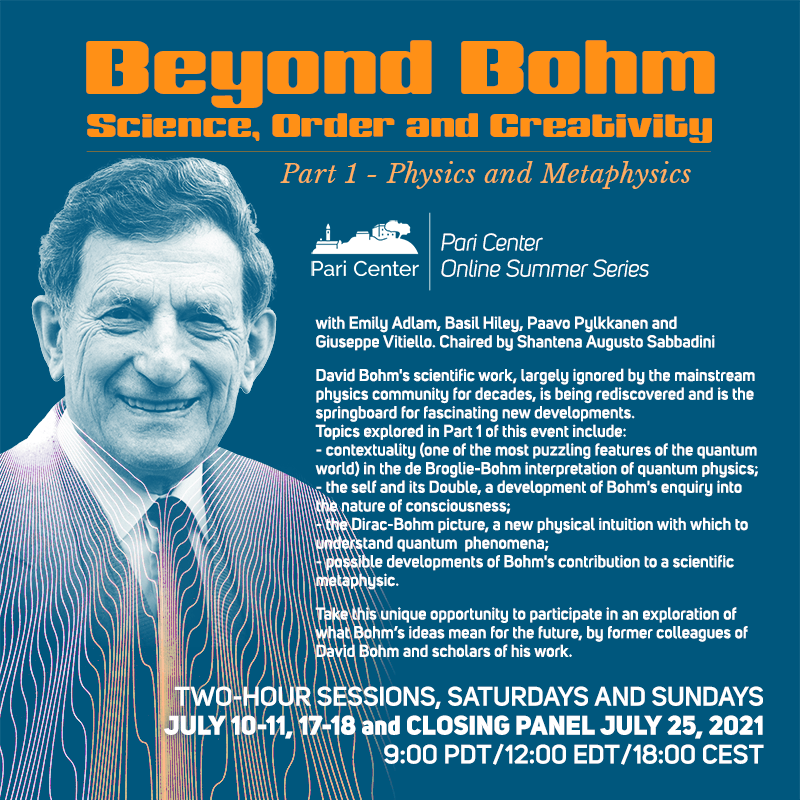
  • Beyond Bohm 2: Closing Session

    Beyond Bohm 2021
    Online

    It may be “auspicious coincidence” – or otherwise – but the first five of the sessions in Beyond Bohm 2 are in one way or another related to participatory consciousness. This overlap occurred without any intention on the part of the individuals who put together each of the sessions. It is likely then, that this topic will figure into our final summary session, though any of the topics addressed in the preceding weeks may come to the fore – especially in the extended discussion and Q &A with those attending this final segment of Beyond Bohm. And in the spirit of dialogue, something completely new may emerge, unforeseen by any plan or agenda.

    €20,00 – €100,00
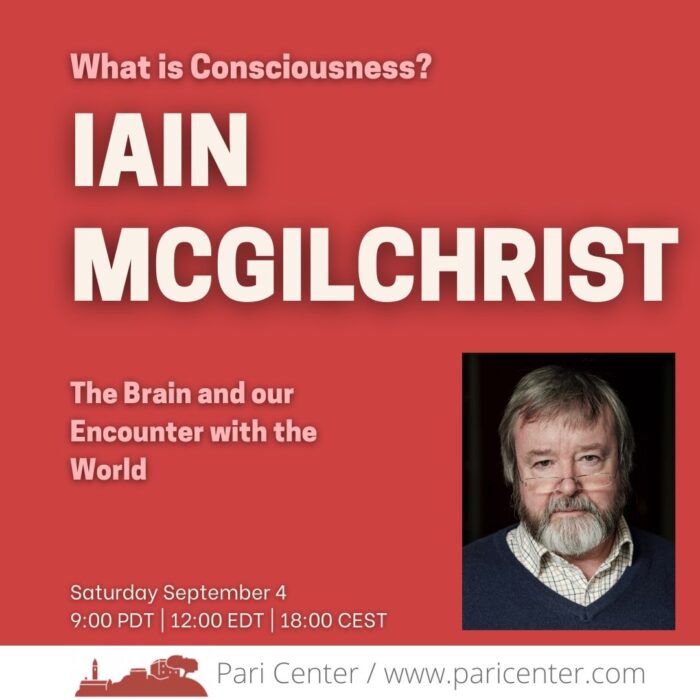
  • The Brain and our Encounter with the World

    Online

    At the very least, our brains help to shape our consciousness. Can an examination of the way in which they do so help us to reconcile different visons of ourselves and of our world?  There is nothing reductionist about asking such a question: rather, McGilchrist shall suggest, it helps us to transcend the limitations of reductionism itself.  Importantly it may, for the first time, give philosophy a basis for judging certain views on the world as worthier of acceptance than others.

    €7,00 – €15,00
  • Exploring the Earth-Mind

    Online

    Indigenous peoples alive today are rooted in a consciousness of Earth that once provided the guiding mode of consciousness for humans but which at this point in time most of the rest of humanity has lost. The mainstream mode of consciousness is the “anthropocentric” or human-centered mode—a consciousness of objects, causality, competition and hierarchy that focuses on the individual self and on the conflict for survival of the individual. By contrast, the holomorphic or Earth-Mind consciousness is a holistic awareness; it’s an awareness of living in dynamic balance with other beings as “relatives,” including mountains, trees, rivers, wind. It’s an awareness of the deeply metaphoric nature of our relationship to reality and of our obligation to engage in “reciprocity” with all beings, animate or inanimate.

    €60,00
  • Imagined Problems: Real Opportunities

    Online

    The science of perception tells us that our problems are subjective and socially constructed. So what is a “real” problem, and what solutions become available to us?  In this engaging session, Drs. Susanna Wu-Pong Calvert, MAPP, PhD and Gary Goldberg, MD discuss the nature of perception and “reality” in our VUCA world (volatile, uncertain, complex, and ambiguous). They will also discuss how to move from feelings of overwhelm and despair to inspiration and agency by accessing our deep, inner wisdom. Joseph Campbell’s Hero’s Journey will be presented as a timeless, increasingly relevant, and useful frame for our individual and collective pursuit of meaning and authentic, impactful action, especially in light of our modern challenges.

    Free
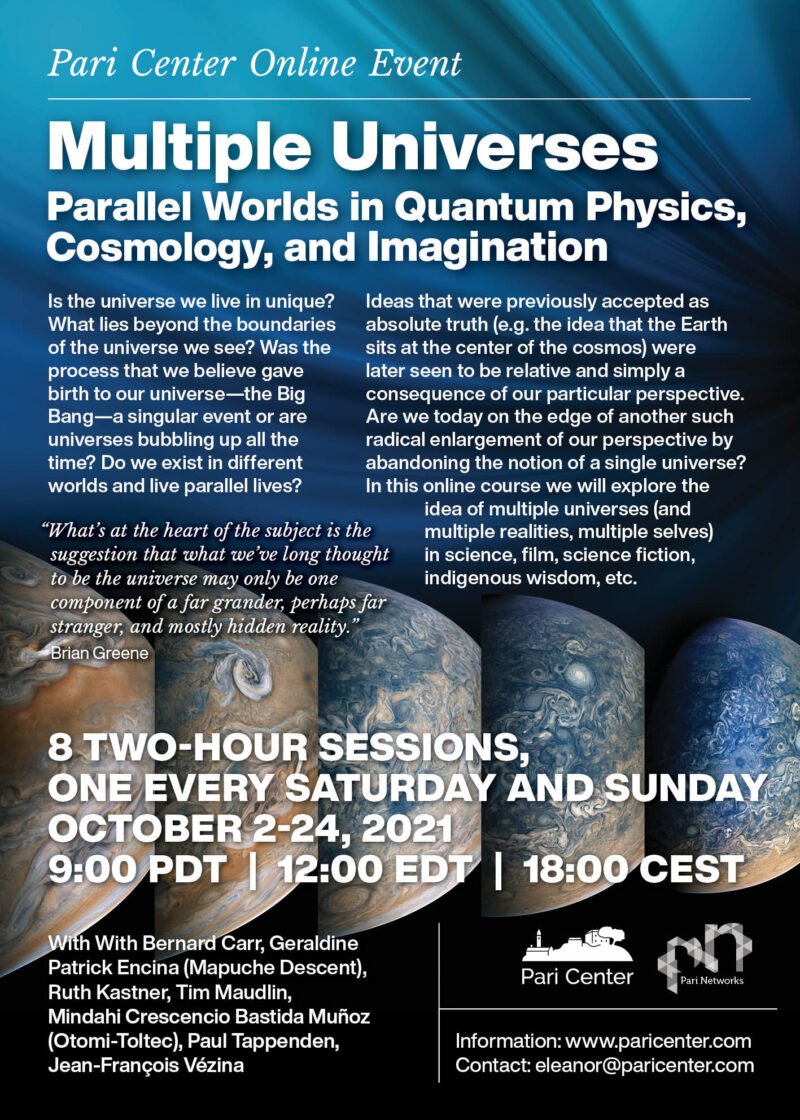
  • Closing Panel: Multiple Universes

    Multiple Universes
    Online

    A panel discussion with some of the speakers of the Multiple Universes series will close the event, reflecting on the various perspectives that have emerged in the presentations and comparing different world views.

    The session will begin by posing the panelists a few key questions to start the discussion. It will continue as a Q&A session open to everybody. You are invited to have your questions and comments ready, and in formulating them please be mindful of other people’s need to ask their own questions! The best questions are often the most concise ones.

    €18,00
  • The Consciousness of Neuroscience

    The scientific study of consciousness used to be taboo just a few decades ago, but it is now in its heyday. Consciousness research captures the imagination of laypeople, attracts research funding, and sells books. Amongst neuroscientists, the dominant position is this: whatever consciousness is, it must somehow emerge somewhere in the brain. Where else could it be? The challenge then is to find out how subjective experience springs from neural activity. But does it? By what kind of modern alchemy is the water of the matter supposed to be transformed into the wine of experience? We are never told. Instead, materialism excels at selling old metaphysical commitments as new scientific data. In addition, materialism is promissory by necessity: the grand resolution is at hand but always lies ahead – the best is yet to come.

    Free