
The Covid pandemic has required us to keep a broader social distance from one another; for psychotherapists this should be less of a problem. With reliable broadband making therapy sessions (and presentations like this one) possible online, why do so many people still find the virtual session falls so far short of the ‘real’ meeting in person? Maybe our assumption that there is a ‘real’ version and there is an inferior ‘virtual’ version is wrong to begin with. Christopher Hauke will lay out three approaches to this question.
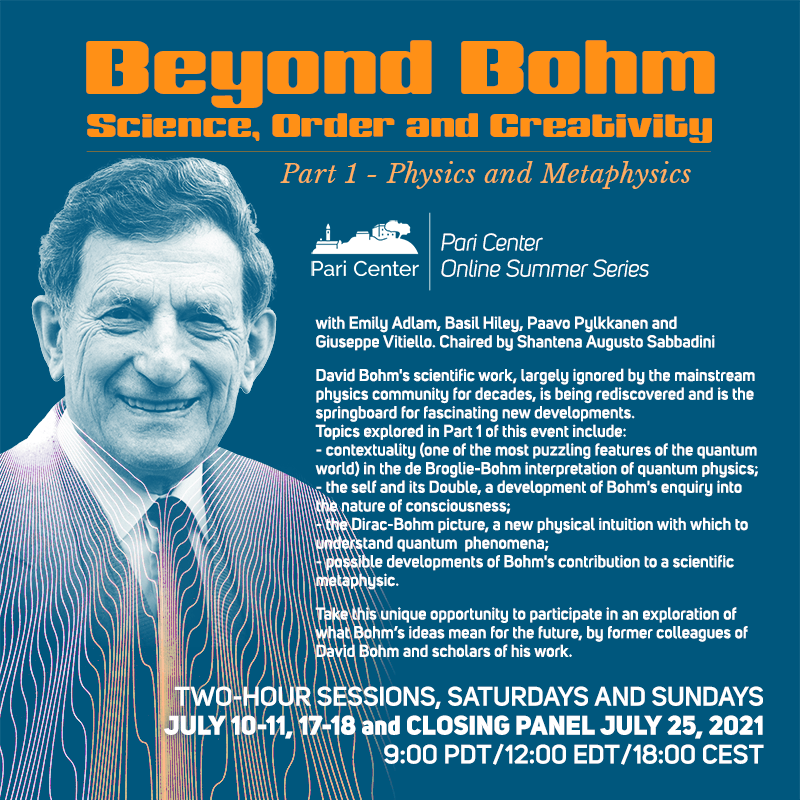
David Bohm has given a fundamental contribution to the still ongoing debate on the interpretation of quantum physics, a contribution largely ignored by the mainstream physics community for decades, but now being rediscovered and taken into consideration both in philosophical debate and in mathematical and experimental developments.
David Bohm’s work has been highly influential in the world of physics, but his philosophical ideas crossed multiple disciplines with a holistic approach. This sequence of presentations will follow some of these ideas, and explore new threads of inquiry inspired by Bohm:
Contextuality is one particularly puzzling non-classical feature of the quantum world—but what conclusions should we draw from it? In this talk, Dr Adlam will explain what contextuality is and why the presence of contextuality in our theories needs explaining. She will describe how contextuality is manifested in the de Broglie-Bohm interpretation of quantum mechanics and compare and contrast the de Broglie-Bohm account of contextuality to various alternatives. Finally, she will discuss some interesting new mathematical approaches to contextuality and consider what these results add to our understanding.
By repeated trial-and-error the brain constructs within itself, through its mental activity, an understanding of its surround, that we describe as its Double. The relation that the self and its Double construct constitutes the meaning of the flows of information exchanged during their interactions. The act of consciousness resides in such a dialogue of the self with its Double. The continuous attempt to reach the equilibrium in this dialogue shows that the real goal pursued by the brain activity is the aesthetical experience, the perfect ‘to-be-in-the-world.’ Active reciprocal responses between the self and the world imply responsibility and thus they become moral, ethical responses through which the self and its Double become part of the larger social dialogue.
It has recently been shown that the Bohm approach outlined in his 1952 work is not a new type of ‘mechanics’ but is unitarily equivalent, i.e. mathematically equivalent, to the Schrödinger approach, dealing directly with canonical coordinates (x, p) rather than through the intermediary ‘wave functions’.  This fits in with the Stone-von Neumann theorem which explains why we already have the Schrödinger ‘picture’, the Heisenberg ‘picture’, the interaction ‘picture’ etc.  We have called it the Dirac-Bohm ‘picture’ based on a non-commutative algebra: it is from this picture that Bohm’s ’52 approach emerges.  The word ‘picture’ is here used in a technical sense, but can be taken as providing a different physical intuition with which to understand quantum phenomena.
David Bohm was concerned with providing a description of reality – at the quantum level, and more generally, a unified description of matter, life, and consciousness, all adding up to a general concept of reality or a metaphysical theory. Such synthetic ontological projects were not popular in much of 20thcentury philosophy and thus Bohm’s philosophical work has been often ignored by professional philosophers. However, it is important to realize that although he was clearly more concerned with describing a mind-independent reality than many other 20th-century physicists or philosophers, this concern did not mean that he ignored the role of the mind (language, perception, etc.) in his attempts to describe reality.
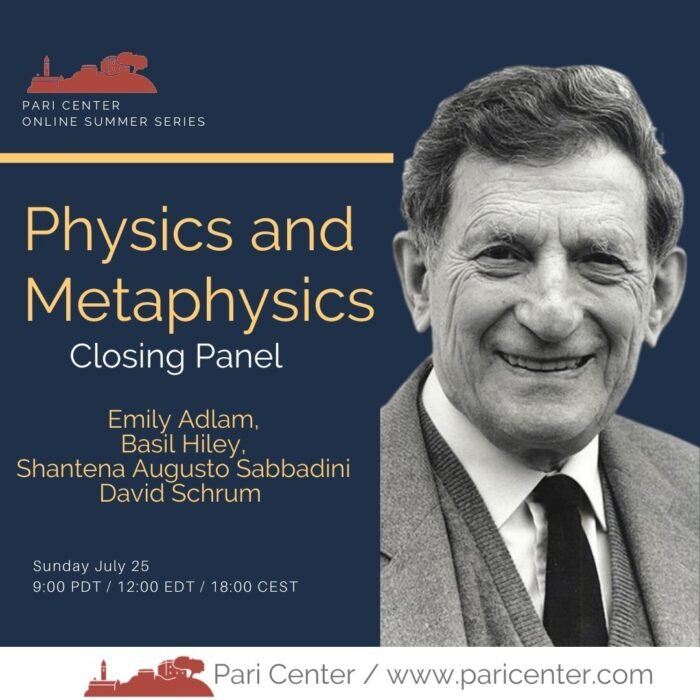
The concluding panel of Part One of the Beyond Bohm event will examine work in progress in various areas related to Bohm’s thought.
The session will start with the panelists describing which developments of Bohm’s thought they consider most important for their work, for their life and for philosophy in general.