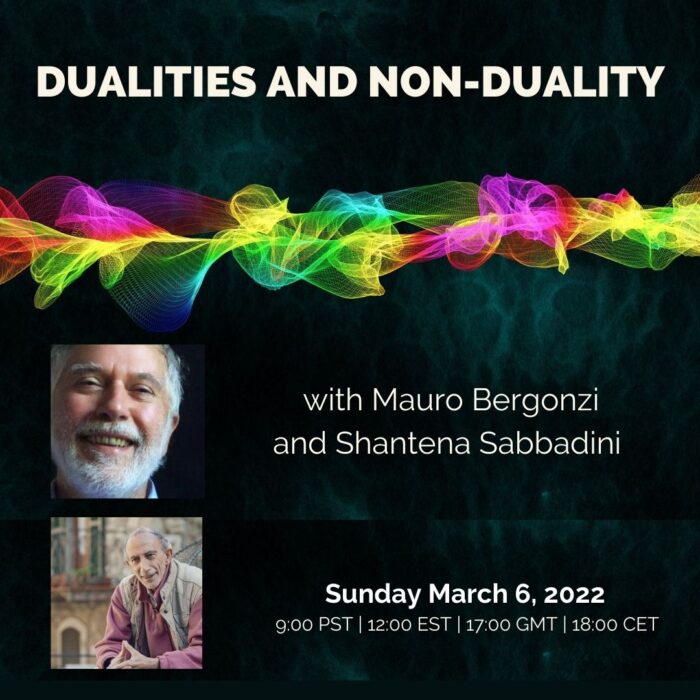
• Dualities and Non-Duality

    Dualities
    Online

    What is the ultimate nature of reality? In our contemporary scientific culture reality appears to consist of a multiplicity of interacting parts. That multiplicity exhibits some fundamental dualities: being and becoming, particle and field, mind and matter.

    On the other hand the main stance of non-duality (advaita in sanskrit) points to the simple fact that in reality there are endless differences, but no separation at all: reality is regarded as an indivisible whole, while the perception of isolated entities is just a mental construct without any cogent ontological foundation (including the idea of a separate ‘ego’ dwelling ‘within’ a single body/mind).

    €15,00
  • An Introduction to Gregory Bateson’s Ecology of Mind

    Online

    Jon Goodbun’s research focuses on ‘ecological thinking’—both in terms of how we think about ecological systems, and how ecological systems themselves think—drawing in particular on his extensive study of the work of the ecological anthropologist Gregory Bateson. In this talk Goodbun will introduce some of the history and thinking of this important theorist, drawing in particular upon some of the ideas contained within his first collection of essays: Steps to an Ecology of Mind, as well as his later synthesis: Mind and Nature—A Necessary Unity, and his final incomplete text, published after his death by daughter Mary Catherine Bateson, called Angels Fear—Towards an Epistemology of the Sacred, and will situate these ideas in relation to more recent research, and the wider research interests of the Pari Center.

    Free
  • Music and Numbers, Part II

    The Quintessence of Music
    Online

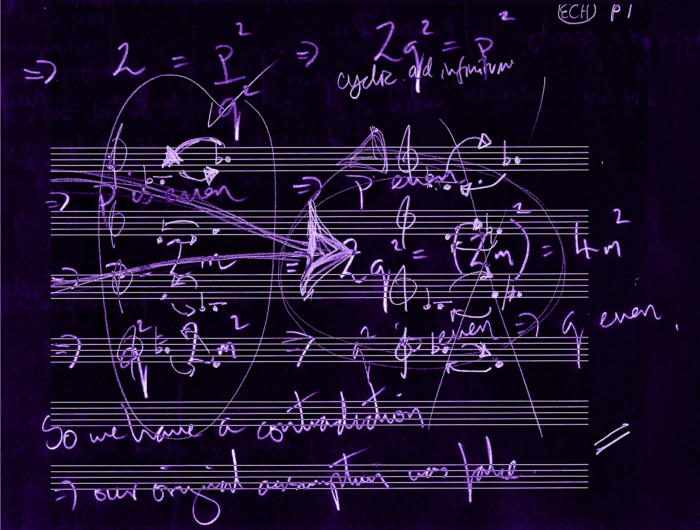
    This session will continue the journey we began in Music and Numbers, Part I. Having embarked upon the landscape comprised of dissonant intervals and avoidance of tonality, we will explore the music of composers working with the so-called Twelve-Tone System: Riccardo Malipiero, Anton Webern, and Luigi Dallapiccola, for whom numbers provided the pathway to their idiosyncratic musical languages. We will begin by considering the way interval relationships in Johann Sebastian Bach’s Sinfonia in F minor create what we know as consonance and compare it to Riccardo Malipiero’s (1914 Milan – 2003 Milan) Invenzione #7, a dissonant work that is modelled upon it. Dr Coleman will demonstrate the way Webern created 144 possible versions of his twelve-tone row using the Magic Square.

    Free
  • Teaching the Dinosaur to Dance: Moving Beyond Business as Usual

    Online

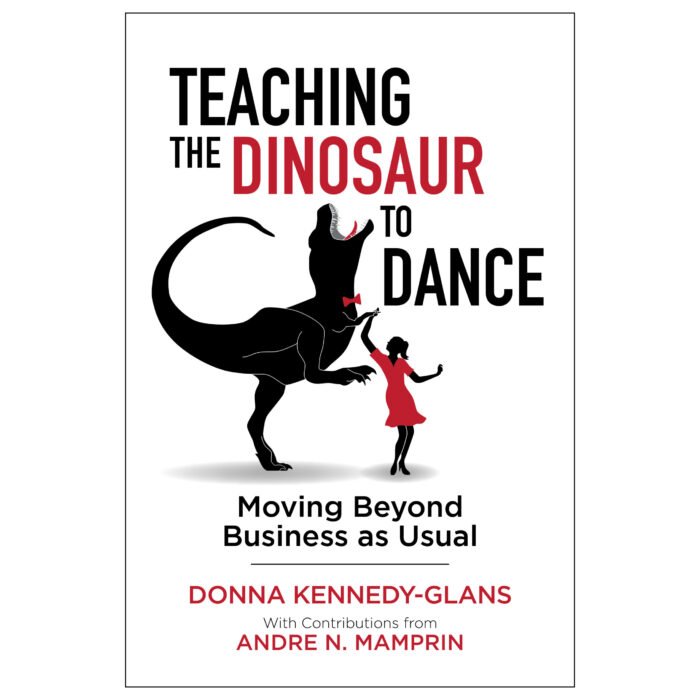
    Donna’s latest book Teaching the Dinosaur to Dance provides the roadmap builders and rebuilders—of society and of enterprise—with the tools to rethink, redesign and revitalize their organizations and to remain relevant and sustainable in a new and very different future. Business as usual is extinct. Disruption and social pressure are the new norm and change is inevitable for enterprises of all kinds—businesses, governments, non-profits, community initiatives and social institutions. We’ve reached a turning point and it’s time to evolve, or we go the way of the dinosaurs. We all need to act now to survive and find new ways to thrive in a changed world. But in an age of polarized debates on complex issues (such as fairness and climate change), how can leaders find a new way forward? How can enterprises re-invent themselves to make capitalism work better for more people? These are some of the compelling and timely issues that Donna and Julie will tackle in their conversation.

    Free
  • Love in the Time of Crisis

    Love in the Time of Crisis
    Online

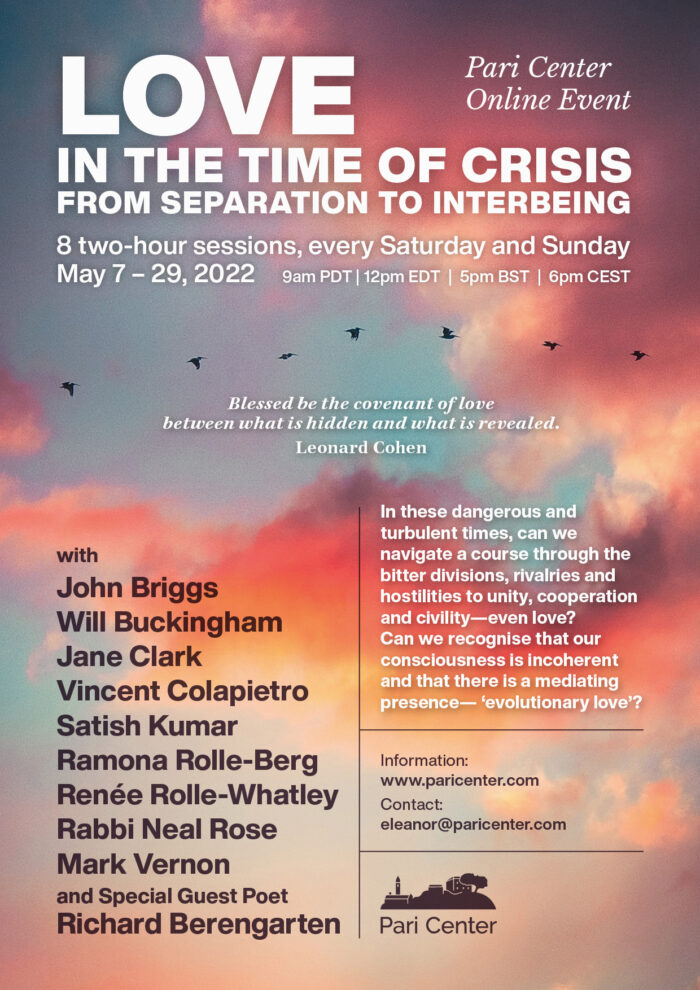
    We live in a challenging time of transition which promises both hope and peril.  How are we to navigate a course that will take us from a story of separation, competition, and distrust to a new narrative of inter-being, cooperation, and love? How do we begin to give up and move beyond an incoherent and too often destructive structure of consciousness and a world which seems rarely to see the mediating presence of what has been called ‘evolutionary love’?

    €100.00
  • Strangers on the Threshold: Love, Wisdom, and the Task of Philosophy

    Love in the Time of Crisis
    Online

    What is philosophy? Why do we philosophise? And why, in a time of crisis, does philosophy matter?

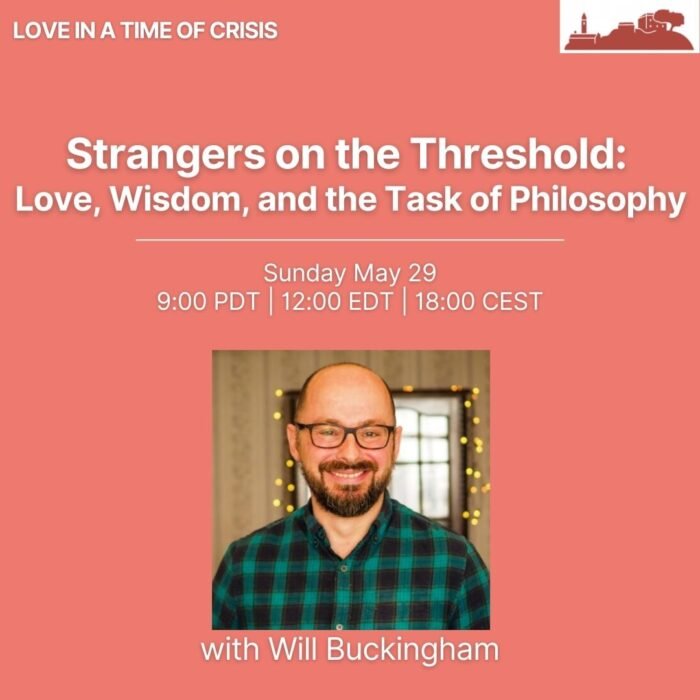
    In a time of crisis, the temptation is often to withdraw, to fall back on our own resources, or to batten down the hatches. But in this talk, writer and philosopher Will Buckingham will explore how Levinas sets out a more challenging, and more fruitful, path. Weaving together philosophy and storytelling, he will argue that in a time of crisis, the greatest philosophical demand may be this: to open up the door.

    €100,00
  • Consciousness, Bohm and the Quest for Intelligibility

    Beyond Bohm 2022
    Online

    David Bohm’s interpretation of quantum mechanics can be understood as driven by a need for an intelligible account of the physics of the world. But Bohm went beyond physics and linked the physics to metaphysics, especially the metaphysics of consciousness. I will explore how the drive towards an intelligible account of the world and our place in it led Bohm to a view of nature which is arguably a form of panpsychism.

    €15,00
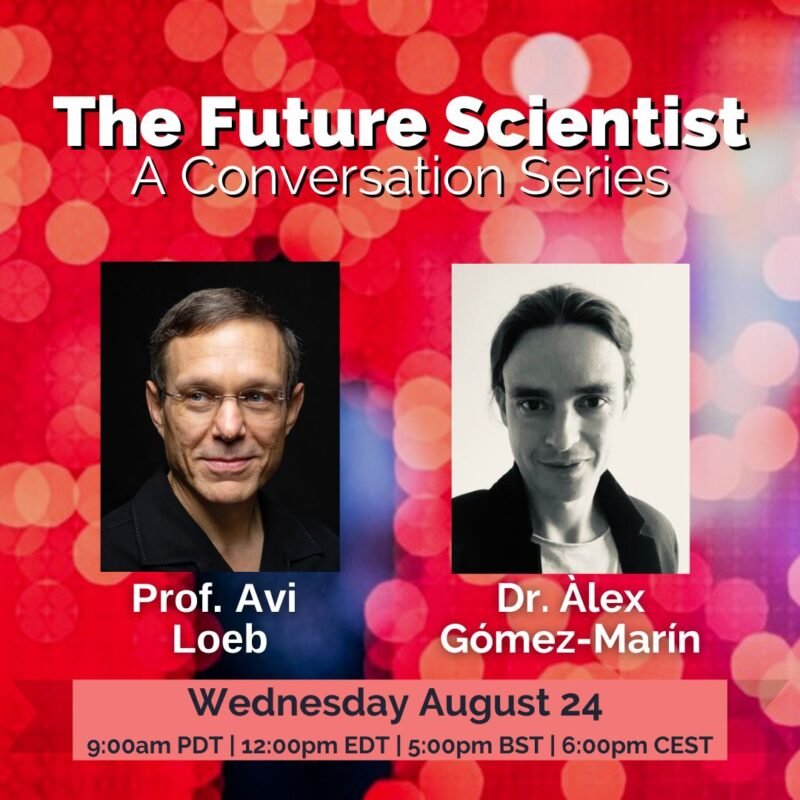
  • The Future Scientist – A Conversation with Prof. Avi Loeb

    The Future Scientist – A Conversation Series
    Online

    In this installment of The Future Scientist series, we will consider the interesting triad formed by the words “evidence”, “experts” and “extraterrestrial”. On October 19th 2017 an interstellar object called ‘Oumuamua was detected passing relatively close to the Earth. Its behavior was anomalous-enough to interpret it as either a natural object of a type never seen before, or as an artificial object. Whether ‘Oumuamua is some sort of extraterrestrial technological debris or not we cannot say with certainty now, but we can certainly prepare ourselves to search for more.

    Free