• Action – The Great Re-Think

    The Great Re-Think

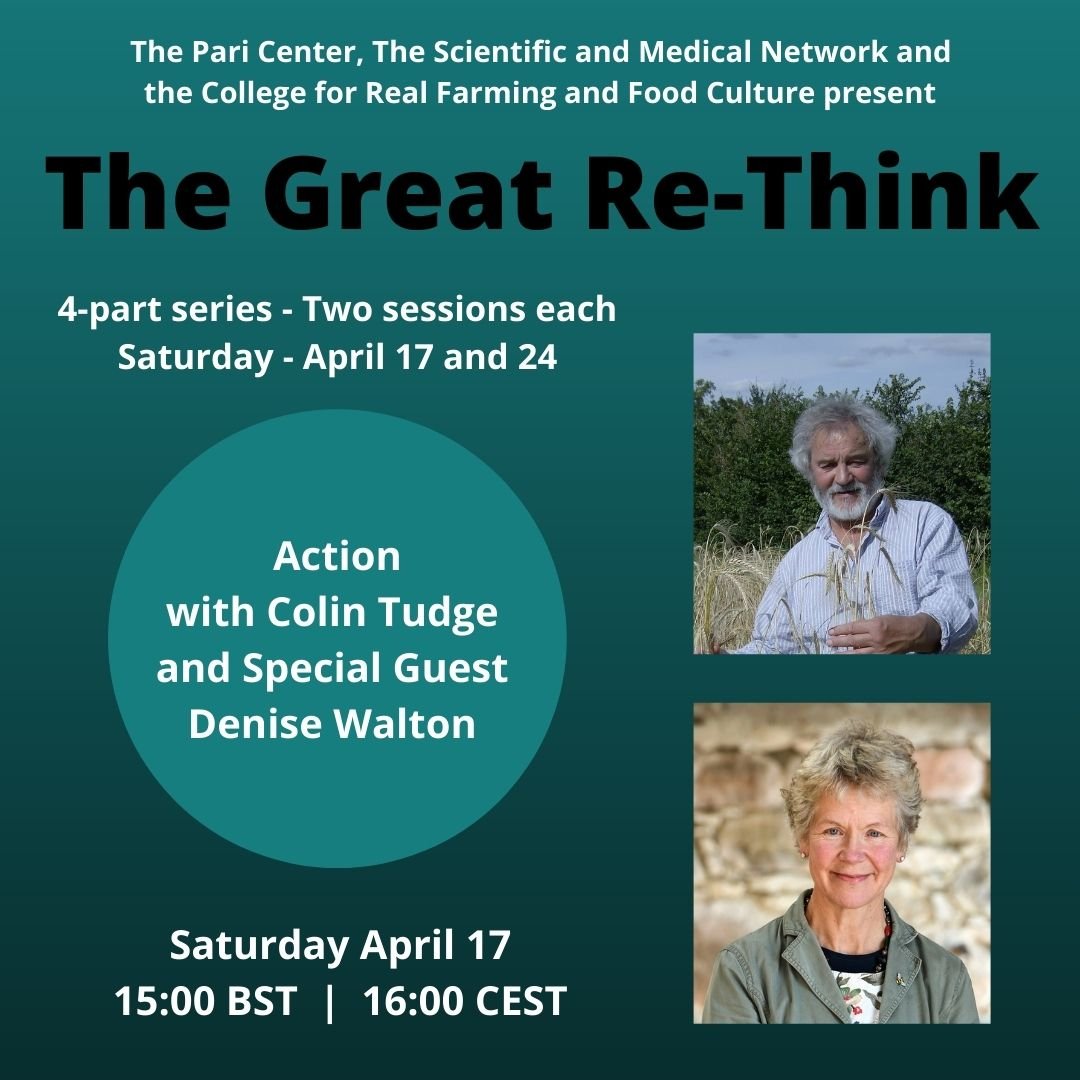
    All technologies are pertinent: both ‘high’—emerging from science; and ‘low,’ aka artisanal or traditional—based on craft. Above all, as E.F. Schumacher said, all technologies must be appropriate—one reason why we need to spell out what we are really trying to achieve!

    Beyond doubt, though—if we truly aim to crate convivial societies while respecting our fellow creatures—the most important technologies and crafts are those of food: agriculture and cooking.

    €45,00
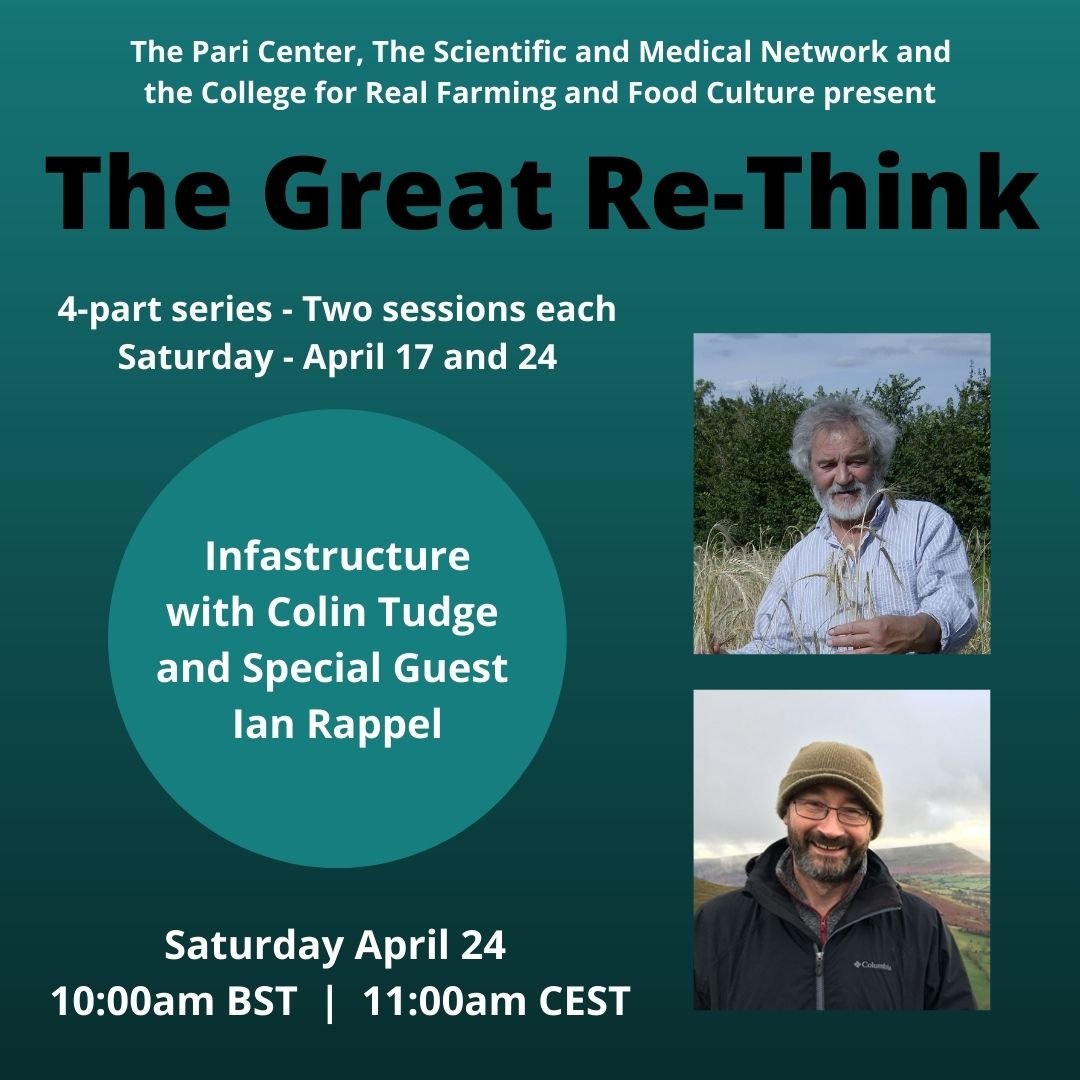
  • Infrastructure – The Great Re-Think

    The Great Re-Think

    Enlightened agriculture (with corresponding cuisine)—and the grand cause of conviviality, personal fulfilment, and a flourishing biosphere—cannot come about without an appropriate, supportive infrastructure—compounded of the government, the economy, and the law. The economy is ‘the matrix of our lives.’ It is in practice the medium through which we translate our aspirations into material reality. So it is vital to have the right aspirations—and to devise an economy that really does help us to meet our needs and fulfil our dreams (insofar as our dreams are compatible with the bedrock principles of morality and ecological reality).

    €45,00
  • Mindset – The Great Re-Think

    The Great Re-Think

    ‘Mindset’ is the sum of all the ideas, preconceptions, prejudices, predilections and aversions in ‘the basement of our minds’ that we take for granted and rarely pull out for inspection—but inspection is at least salutary and indeed is necessary. The Great Re-Think discusses mindset under four headings: science, morality, metaphysics, and the arts. Very briefly:

    €45,00
  • Flickering Reality: Persona: Masks that Conceal, Masks that Reveal

    Flickering Reality

    In this session, we will use three films as our springboard to exploring Jung’s notion of the persona:  Wall Street (1987), The Mask (1994) and The Farewell (2019).  While each film highlights the potentially pathological relationship one can have with one’s personas, they also convey the important role played by this archetypal imperative in personality development. As with all archetypes, the persona is bipolar in nature and entering into a more integral relationship with its various qualities and characteristics is central to the project of individuation.

    Free
  • Ancient Wisdom Transforming Tomorrow

    Online

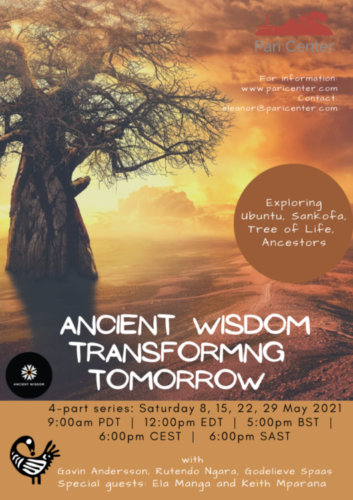
    We find ourselves in a world in crisis. While theories abound, to some humanity is at the edge of the apocalypse. We are at a time of reckoning, a time of turning. We are both actors and spectators in the time foretold by ancient prophecy.

    There has been no greater symbol of this in recent history than the global health emergency due to Covid-19. As a consequence of the virus, borders have been closed, millions of sources of livelihood have been lost, systems have been stifled, economies have suffered, and all the ills of the world have been accentuated. At the peak of the pandemic, the world was stopped in its tracks and activity—as we knew it—and was locked down. Some point out that this may just be the first such pandemic, and that it is merely a harbinger of the crises to come with climate change.

    €95
  • Hope and Delusion

    Online

    When we realise just how much hangs on our attitudes towards the various forms of crisis we are exposed to, we may come to see what our work really is. Hope has a curious story to tell. It reminds us of the wealth we carry within us, but also of how easily we are persuaded to give it all up. This talk attempts to string together disparate stories relating to, but not necessarily about, hope, and aims specifically to raise more questions than it answers. Accompanying the talk there will be breakout and plenary sessions in which participants will be able to articulate their thoughts and responses.

    Free
  • Analytic Idealism

    What Is Consciousness?
    Online

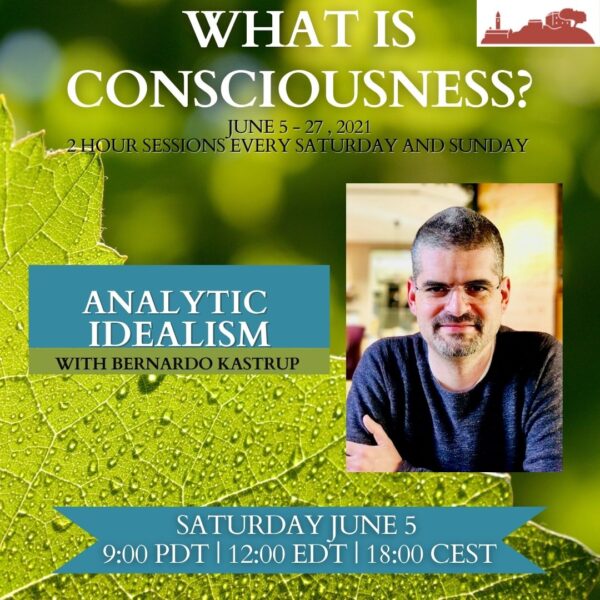
    Two widespread current notions of consciousness are physicalism, i.e. the perspective that assumes physical reality, matter, as fundamental, and bottom-up panpsychism, i.e. the perspective that takes everything as possessing mind or consciousness and higher levels of consciousness consisting of a combination of more elementary levels. Bernardo Kastrup will argue for an idealist (consciousness only) ontology consistent with empirical observations, which seeks to explain the facts of nature more parsimoniously than physicalism and bottom-up panpsychism. This ontology also attempts to offer more explanatory power than both physicalism and bottom-up panpsychism, in that it does not fall prey to either the ‘hard problem of consciousness’ (the challenge of deducing consciousness from matter) or the ‘subject combination problem,’ (the challenge of deducing higher levels of consciousness from lower levels).

    €160,00
  • Can Quantum Mechanics Solve the Hard Problem of Consciousness?

    What Is Consciousness?
    Online

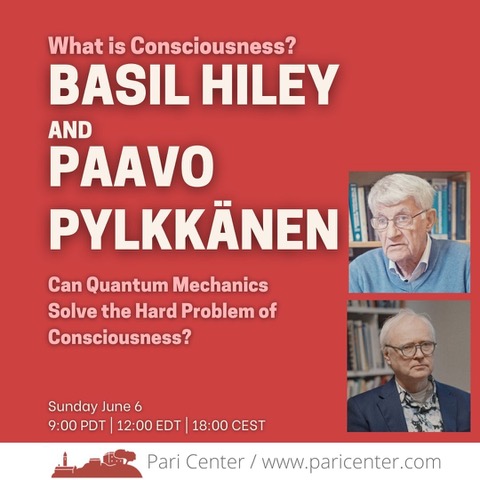
    The hard problem of consciousness is the problem of explaining how and why physical processes give rise to consciousness. Regardless of many attempts to solve the problem, there is still no commonly agreed solution. It is thus very likely that some radically new ideas are required if we are to make any progress. In this presentation we turn to quantum theory to find out whether it has anything to offer in our attempts to understand the place of mind and conscious experience in nature. In particular we will be focusing on the ontological interpretation of quantum theory proposed by Bohm and Hiley and its further development by Hiley and its philosophical interpretation by Pylkkanen.

    €160,00
  • Mundane and Mystical: A Panentheistic Perspective on C. G. Jung’s Late Thoughts About Consciousness, Ego, and Self

    What Is Consciousness?
    Online

    C. G. Jung insisted that there could be no consciousness without an ego, and accordingly he expressed scepticism about the desirability and even the possibility of experiencing pure consciousness or egoless awareness—a view seemingly at odds with worldwide mystical experience as well as much Asian philosophy. In his presentation Roderick will re-examine Jung’s position on this issue in light of Jung’s own mystical experiences in 1944, some late developments in his thinking about the relationship between the ego and the self, and the case for his being viewed as an implicit panentheist. He will argue that Jung’s  thought can provide a much richer and more socially relevant account of mystical experience, including of the experience of egoless awareness, than is often supposed and than some of his own comments might lead one to expect.

    €45,00