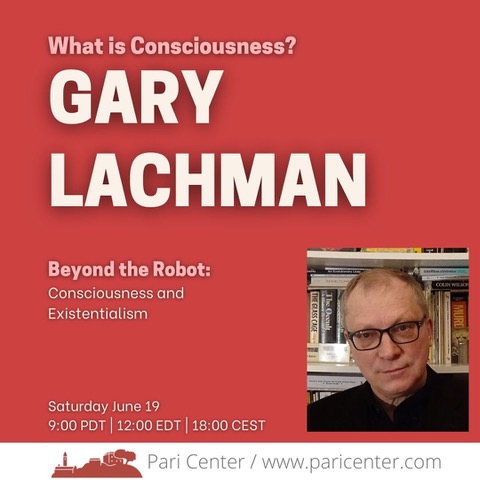
• Beyond the Robot: Consciousness and Existentialism

    What Is Consciousness?
    Online

    Lachman will base his presentation on the work of Colin Wilson and his ‘new existentialism,’ a phenomenological analysis of the habits that keep us from experiencing consciousness as we should (that would be more along the lines of Maslow’s ‘peak experience’), the ‘dampers’ we unconsciously place over our perceptions that can lead to depression, angst, and existential despair. This ‘muffling’ of experience is the result of a necessary editing process, that allows us to maneuver through life successfully.

    €160,00
  • What Is the Neural Correlate of Consciousness?

    What Is Consciousness?
    Online

    This presentation will discuss some of the complexities in understanding what exactly a conscious experience is, as different groups (philosophers and physicians, for example) describe it very differently. We will then look at the multitude of suggestions for the NCC and try to draw some conclusions about what the NCC could be based on these ideas. We will also explore the reasons some scholars believe that trying to identify the NCC is a fool’s errand and whether these reasons make sense from a scientific point of view.  Finally, we will examine the “embodied cognition” movement can shed some light on these issues.

    €160,00
  • The Inner Science, Experiential Investigation, and Analysis of Consciousness

    What Is Consciousness?
    Online

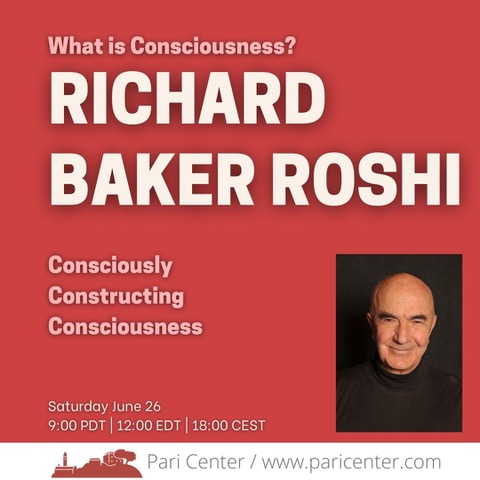
    To practice Zen means to observe the fact and process of knowing. Consciousness is the most visible face of our mutualized knowing, a knowing through others and within the proximal spectrum of phenomenality. To closely and dispassionately observe the activity and functioning of consciousness, it is necessary, additionally, to actualize a transformational ‘awareness-observing-consciousness.’ This is a shift in kind: a shift from a self- referencing, comparative consciousness to a non-self- referencing, non-comparative awareness.

    €160,00
  • Closing Panel: What is Consciousness?

    What Is Consciousness?
    Online

    We have now reached the end of our ‘What is Consciousness?’ event. We have explored the many aspects of the topic through the eyes of scholars some of whom had opposing viewpoints but all of whom were both compelling and enlightening. We are pleased that so many of them have agreed to take part in a final panel to explore and deepen some of the themes that have emerged in the presentations.

    Free
  • The Screen and the Soul

    The Covid pandemic has required us to keep a broader social distance from one another; for psychotherapists this should be less of a problem. With reliable broadband making therapy sessions (and presentations like this one) possible online, why do so many people still find the virtual session falls so far short of the ‘real’ meeting in person? Maybe our assumption that there is a ‘real’ version and there is an inferior ‘virtual’ version is wrong to begin with. Christopher Hauke will lay out three approaches to this question.

    Free
  • Contextuality in de Broglie-Bohm and Beyond

    Beyond Bohm 2021
    Online

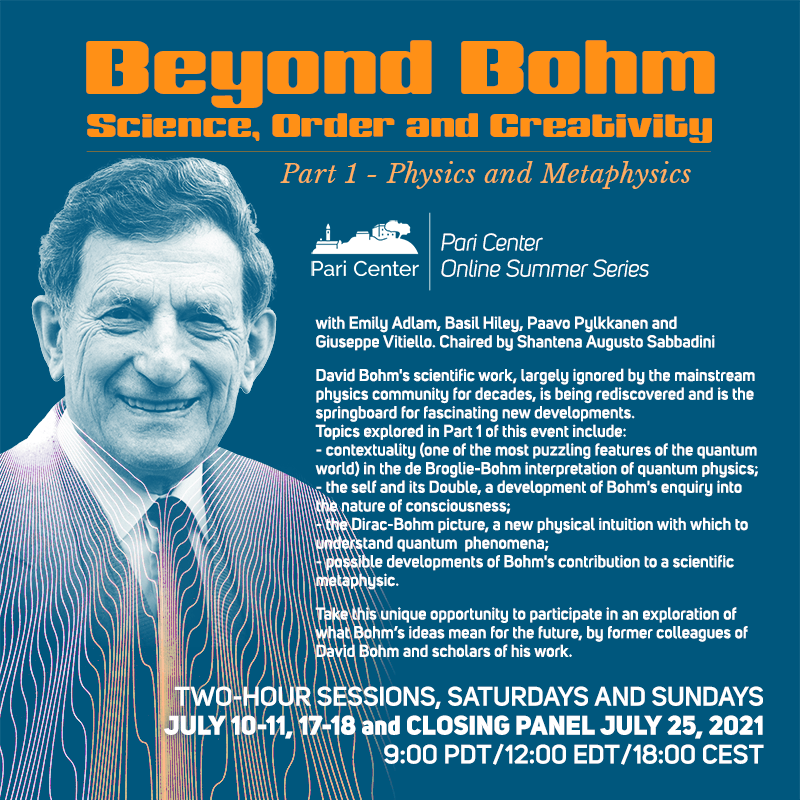
    Contextuality is one particularly puzzling non-classical feature of the quantum world—but what conclusions should we draw from it? In this talk, Dr Adlam will explain what contextuality is and why the presence of contextuality in our theories needs explaining. She will describe how contextuality is manifested in the de Broglie-Bohm interpretation of quantum mechanics and compare and contrast the de Broglie-Bohm account of contextuality to various alternatives. Finally, she will discuss some interesting new mathematical approaches to contextuality and consider what these results add to our understanding.

    €20,00
  • The Brain and its Mindful Double

    Beyond Bohm 2021
    Online

    By repeated trial-and-error the brain constructs within itself, through its mental activity, an understanding of its surround, that we describe as its Double. The relation that the self and its Double construct constitutes the meaning of the flows of information exchanged during their interactions. The act of consciousness resides in such a dialogue of the self with its Double. The continuous attempt to reach the equilibrium in this dialogue shows that the real goal pursued by the brain activity is the aesthetical experience, the perfect ‘to-be-in-the-world.’ Active reciprocal responses between the self and the world imply responsibility and thus they become moral, ethical responses through which the self and its Double become part of the larger social dialogue.

    €20,00
  • The Dirac-Bohm Picture: Bohm’s 1952 Approach in a Wider Context

    Beyond Bohm 2021
    Online

    It has recently been shown that the Bohm approach outlined in his 1952 work is not a new type of ‘mechanics’ but is unitarily equivalent, i.e. mathematically equivalent, to the Schrödinger approach, dealing directly with canonical coordinates (x, p) rather than through the intermediary ‘wave functions’.  This fits in with the Stone-von Neumann theorem which explains why we already have the Schrödinger ‘picture’, the Heisenberg ‘picture’, the interaction ‘picture’ etc.  We have called it the Dirac-Bohm ‘picture’ based on a non-commutative algebra: it is from this picture that Bohm’s ’52 approach emerges.  The word ‘picture’ is here used in a technical sense, but can be taken as providing a different physical intuition with which to understand quantum phenomena.

    €20,00
  • Understanding the Nature of Reality and Consciousness: Bohm’s Philosophical Project

    Beyond Bohm 2021
    Online

    David Bohm was concerned with providing a description of reality – at the quantum level, and more generally, a unified description of matter, life, and consciousness, all adding up to a general concept of reality or a metaphysical theory. Such synthetic ontological projects were not popular in much of 20thcentury philosophy and thus Bohm’s philosophical work has been often ignored by professional philosophers. However, it is important to realize that although he was clearly more concerned with describing a mind-independent reality than many other 20th-century physicists or philosophers, this concern did not mean that he ignored the role of the mind (language, perception, etc.) in his attempts to describe reality.

    €20,00