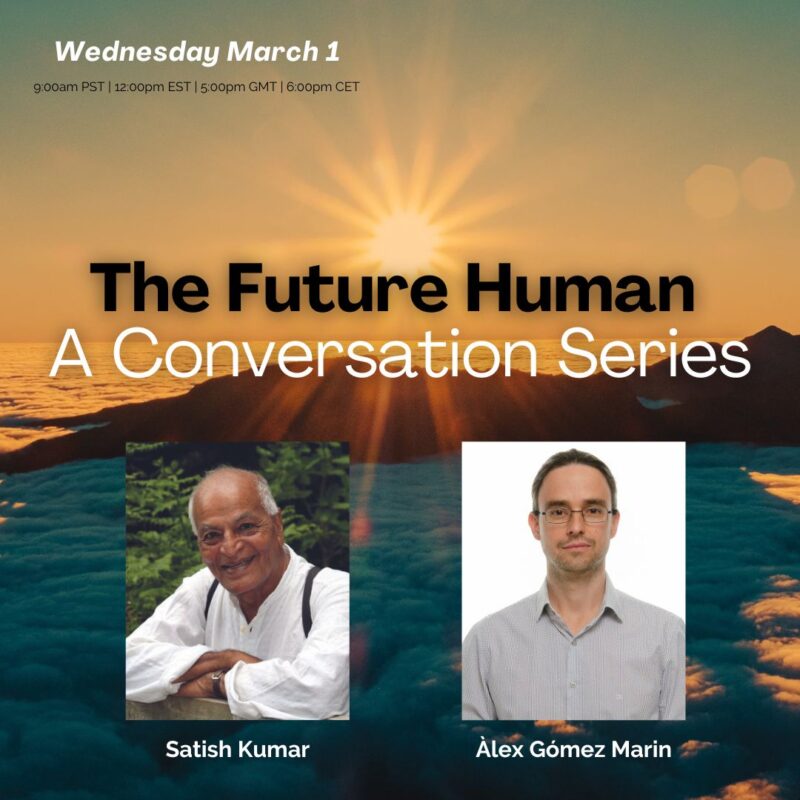
The Future Human – A Conversation with Satish Kumar
OnlineThe second conversation in this series will be on Wednesday March 1, 2023 with Satish Kumar. Our conversation will orbit around “Love”.

The second conversation in this series will be on Wednesday March 1, 2023 with Satish Kumar. Our conversation will orbit around “Love”.

Methods for investigating mind-matter interactions were proposed by Sir Francis Bacon at the very origins of empiricism, over three centuries ago. Systematic scientific studies began about a century ago. In this talk, I will briefly review the modern experimental literature on “psychokinetic” effects, then I will present in more detail experiments I have conducted involving random physical systems based on quantum indeterminacy, photon polarization, scattering, and entanglement, the molecular structure of water, growth of plants and stem cells in vitro, and influences on human mood and physiology. I will also discuss the epistemological challenges in conducting these kinds of studies, as well as the practical and philosophical implications of mind-matter entanglements.

I will discuss the implications of the concept of nonlocality and hidden variables to our understanding of life in the real world. Making a concrete analogy between quantum systems and humane societies reveals a way of being-in-the-world that is not only more Beautiful and True but also Good. I will argue that the revolutionary discoveries of the quantum revolution inform and inspire current revolutions in ecology, agriculture, and politics.
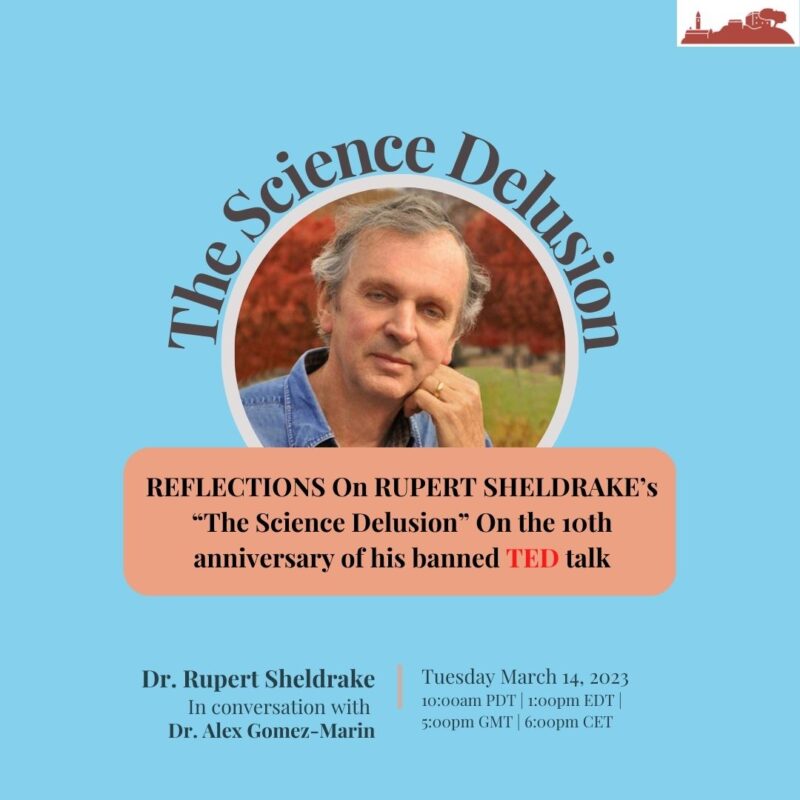
In January 2013 Rupert Sheldrake gave a talk at TEDx Whitechapel entitled “The Science Delusion” where he questioned ten fundamental beliefs of mainstream science. The event was called “Visions for Transition: Challenging existing paradigms and redefining values (for a more beautiful world)”. After protests from two militant materialists, P.Z. Myers and Jerry Coyne, and in consultation with an undisclosed Scientific Board, TED declared: “we feel a responsibility not to provide a platform for talks which appear to have crossed the line into pseudoscience.”
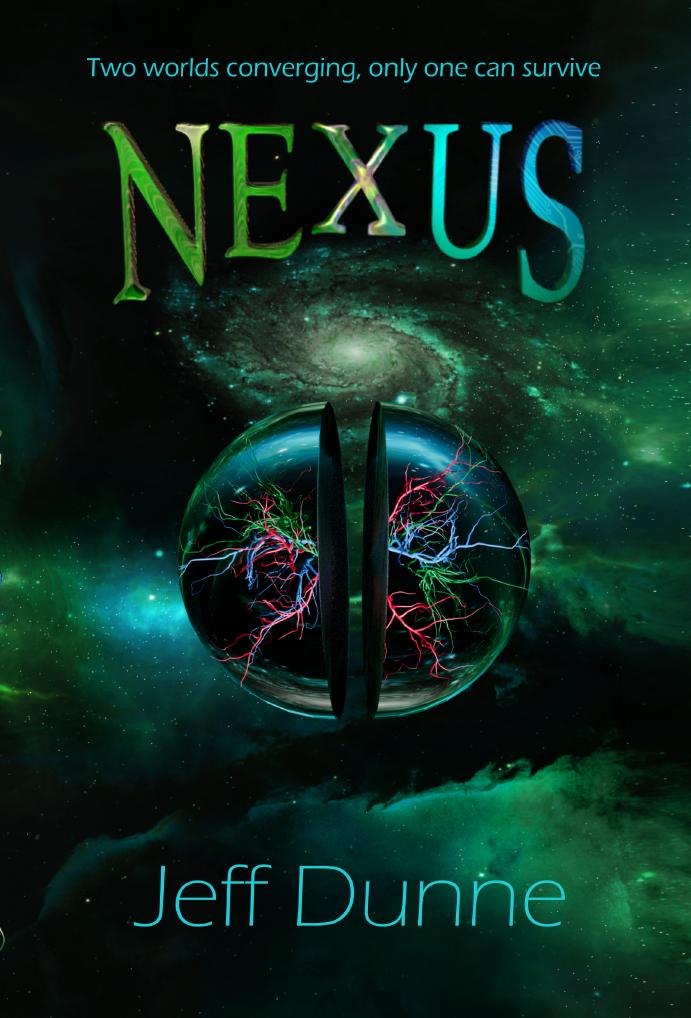
In his recently published book, Nexus, Jeff brings unites three decades of scientific experience with four decades of pursuits in philosophy and metaphysics to weave a story that introduces the principle of syntropy and its importance of finding balance at every scale – personal, societal, and global. Jeff’s driving passion is to help transform our world such that materialism gives way to the recognition of the crucial role that consciousness plays in the formation of reality.

Do plants have feelings? How blind are we to their own internal experiences? Perhaps they offer an untapped opportunity to reconsider how we understand ourselves. What about bees? Do we appreciate their unique cognitive abilities, both as a group and as individuals? Their brains may grant them a kind of consciousness akin, or not, to ours. And, what about cells? How does bioelectricity contribute to their collective problem-solving?
Plants can be knocked out using the very same drug that your vet might use to put your pet to sleep. Although demonstrations of “plants under anaesthesia” provides the perfect blank slate from which to begin to view plants in an entirely new way, this just the beginning. Take sleep; do plants sleep? Or can plants suffer from jet lag? Most people would assume I am talking metaphorically in my hot off the press Planta Sapiens. And yet, planta sapiens is not unlike Harari’s Sapiens, if you see what I mean.

Most of us are aware of the hive mind—the power of bees as an amazing collective. But do we know how uniquely intelligent bees are as individuals? Lars Chittka draws from decades of research, including his own pioneering work, to argue that bees have remarkable cognitive abilities. He shows that they are profoundly smart, have distinct personalities, can recognize flowers and human faces, exhibit basic emotions, count, use simple tools, solve problems, and learn by observing others. They may even possess consciousness.
Each of us takes a remarkable journey from physics to mind: we start as a blob of chemicals in an unfertilized quiescent oocyte and becomes a complex, metacognitive human being. The continuous process of transformation and emergence that we see in developmental biology reminds us that we are true collective intelligences – composed of cells which used to be individual organisms themselves. In this talk, I will describe our work on understanding how the competencies of single cells are harnessed to solve problems in anatomical space, and how evolution pivoted this scaling of intelligence into the familiar forms of cognition in the nervous system.

This talk is about the radical idea that if there is anything uniquely human about our minds, it doesn’t actually matter. Our desire to feel special, better-than, and different-from other forms of intelligent life is not inspiring, beneficial, or supportive of transformation or self-transcendence. In contrast, the ability to love all that is, exactly as it is without suffering is rare among humans and apparently more common among non-humans.