• David Bohm Dialogue: Is There a Different Way to Talk Together

    Online

    This dialogue program is an invitation both to those new to dialogue and those who have participated previously. It is a journey together, without leaders or followers. Registrants and convenors enquire as co-participants, as we explore the movement of conscious mind and touch into what may lie beyond.

    Each week a presenter will offer a brief introduction to a dialogue theme. Group dialogues of about two hours will follow. All convenors will participate in each session. Through this series, our weekly introductory focus will progress—beginning from (1) a general overview, then moving to (2) self, (3) the other, (4) the group as a whole, (5) silence and (6) the dialogic field. In practice, however, our intention is that every session may bring in all these aspects and that we explore without boundaries, in freedom.

    €105,00

  • Online Pari Community Conversations: What is ‘I’? with Yuriko Sato

    Online

    The Jungian analyst, James Hillman, wrote, ‘There is only one core issue for all psychology. Where is the “me”? Where does the “me” begin? Where does the “me” stop? Where does the “other” begin?’ In other words, ‘What is I?’ When we dream at night, is ‘I’ dreaming or being dreamed? Is it also ‘I’ who appears in someone else’s dream? In the Japanese language, there are different words to express ‘I’ according to relationship and occasion. So, what is ‘I’?

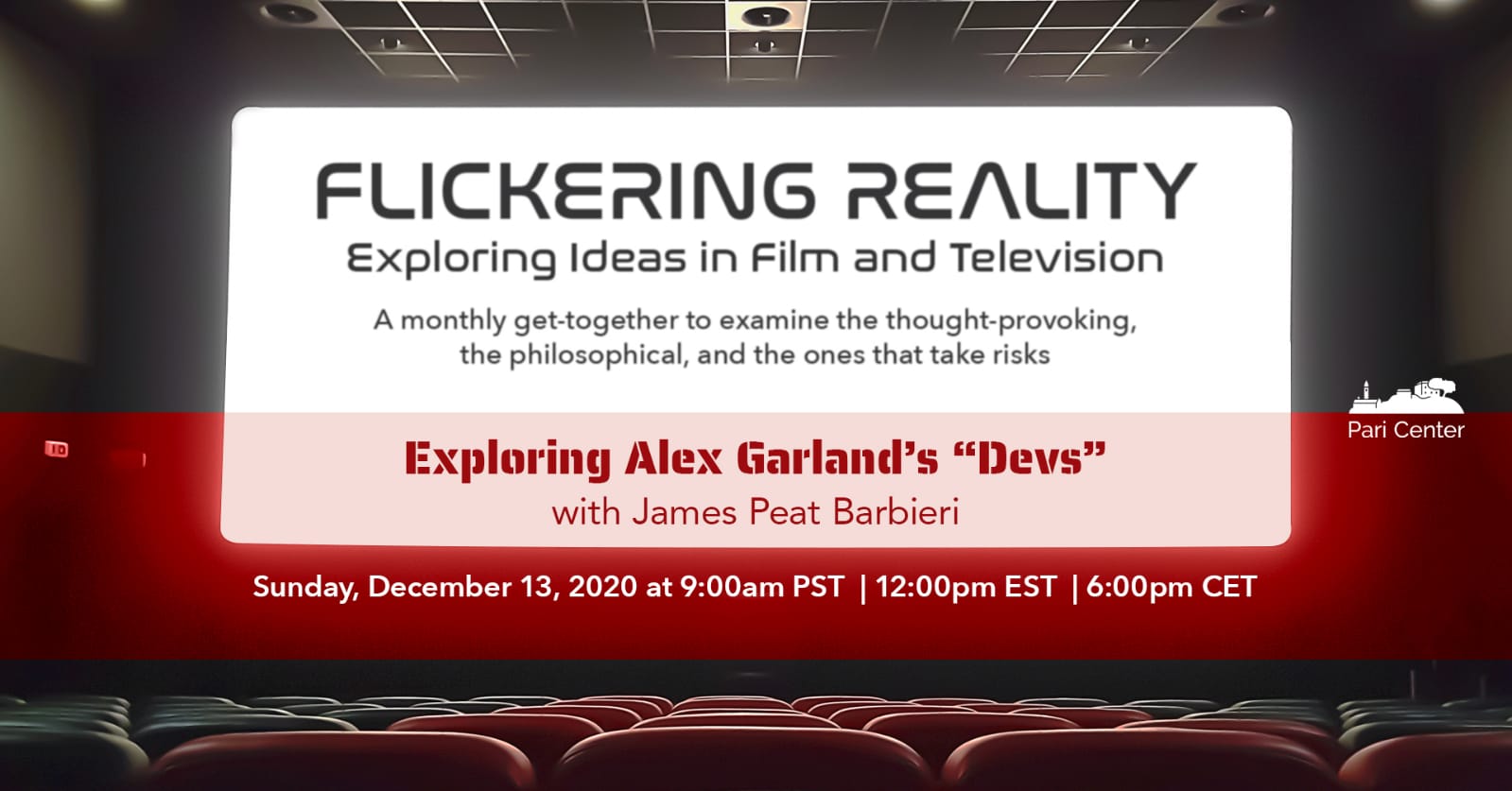
  • Flickering Reality: Exploring Alex Garland’s “Devs” with James Peat Barbieri

    Flickering Reality
    Online

    James Peat Barbieri will explore the ideas that arise from Alex Garland’s Devs (2020). This 8-part series follows the story of the secret department of a high-tech company, which is developing a quantum computer that will be able to determine the past and the future by analysing data from the present. This session will take a look at the ideas in physics used in the show, such as Bohm and Everett’s interpretations of Quantum Mechanics, the philosophical implications of living in a deterministic world, and the meaning of faith in science and in the creators of visionary technologies.The session will be followed by Q&A and discussion.

    Free
  • What Breakthroughs in Science Can We Reasonably Predict?

    It is much easier to talk about advances in the field of science in the past than to guess about its future. The case of Lord Kelvin’s 1900 statement concerning the two little clouds that still obscured the sky of physics, and that would eventually be resolved into revolutionary theories—special relativity and quantum mechanics—is a well-known example of this. While risky, guesses about the future of science are appealing. Indeed, dramatic change is a recurrent theme in science studies as illustrated by Thomas Kuhn’s ideas on shifting paradigms in scientific revolutions as well as by several other authors who elaborated different views on the subject. Informed guesses about the future of science breakthroughs will be the subject of our conversation.

    €10,00
  • Synchronicity Quest with Remo Roth

    Synchronicity, Mind and Matter
    Online

    Experiencing synchronicities is the observation of spontaneous incarnation phenomena in our consciousness.

    Beginning with Jung’s Scarab Synchronicity, Roth outlines the conscious preconditions for the experience of synchronicities. In other words: What change in our consciousness is necessary for the observation of a multiplication of synchronicities?

    €25,00
  • Necessary Chances: Synchronicity in the Encounters that Transform Us

    Synchronicity, Mind and Matter
    Online

    People often enter our lives in mysterious ways. We have all met ‘by accident’ a person who crossed our path and radically altered our trajectory and opened a new door that helped us to enter a new universe. What predisposes us to such meetings? Who are these Trickster’s messengers—not necessarily people, as they can also take the forms of books or movies—that lead us to cross a new threshold?

    €25,00
  • Numinous Matter: Synchronicity and the Reanimation of the Physical World

    Synchronicity, Mind and Matter
    Online

    In this session we shall explore the implications of synchronicity for our experience of and relationship to the physical world.  The presumption of disenchanted science is that matter is in itself inherently inert and devoid of meaning.  Contrary to this, with the concept of synchronicity as well as his use of alchemical symbolism, Jung proposed that meaning and numinosity, as expressions of the psychoid archetype, could be inherent properties of not only the psyche but also matter. Such a view arguably fosters a more participative and respectful, rather than instrumental and exploitative, relationship to the physical world.  We shall examine some of the experiences and underpinning philosophical assumptions that have been invoked in support of this view.

    €25,00
  • Synchronicity: A Common Reality in Japan

    Synchronicity, Mind and Matter
    Online

    Since time immemorial, before C.G. Jung named the phenomenon, synchronicity has been perceived by people of various cultures. In the modern Western world view, mind and matter are clearly separated. Synchronistic phenomena, which cross the boundary between and connect these two distinct categories of reality, are therefore intriguing. However, in places where older world views have been retained in some way, such as in Japan, people seem to be less curious than Westerners about why and how synchronistic events happen; they seem to think of them more as natural occurrences—“just so” and “it happens.” I will approach synchronicity from these perspectives, using the Japanese psyche as an example, to explore its nature.

    €45,00