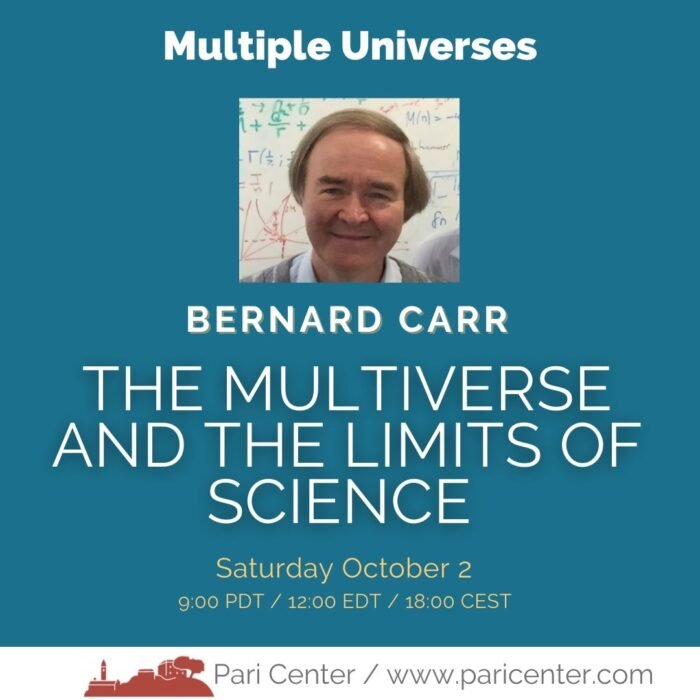
• The Multiverse and the Limits of Science

    Multiple Universes
    Online

    Developments in both cosmology and particle physics suggest that our universe may just be one member of an ensemble of universes, termed the multiverse. However, there are many different versions of the multiverse proposal, so it is important to distinguish between these in assessing the plausibility of the notion. In some versions the values of the physical constants may vary across the ensemble, so this could provide a scientific basis for the suggestion that some of the constants are fine-tuned for the existence of observers. The evidence for this comes from numerous unexplained ‘coincidences’ between the constants, a notion which used to regarded as purely philosophical or even theological.

    €18,00
  • Dendritic Quantum Mechanics

    Multiple Universes
    Online

    The advent of quantum mechanics in the 1920s brought with it the idea that fundamental physical processes may be stochastic which is to say random but constrained by probabilistic law. Rather than the future being determined in advance, as envisaged by Newtonian mechanics, one actual future is stochastically selected from a range of alternativepossibilities. A way to restore determinism to physics is to replace the idea of a stochastic process with that of a dendritic process where all (possible) outcomes actually occur, each in a different (branch) of a burgeoning quantum multiverse. The idea has been much discussed but remains very controversial. Paul explains some of the conceptual difficulties involved and how the idea may be linked to a non-standard materialist conception of the mind-body relation.

    €18,00
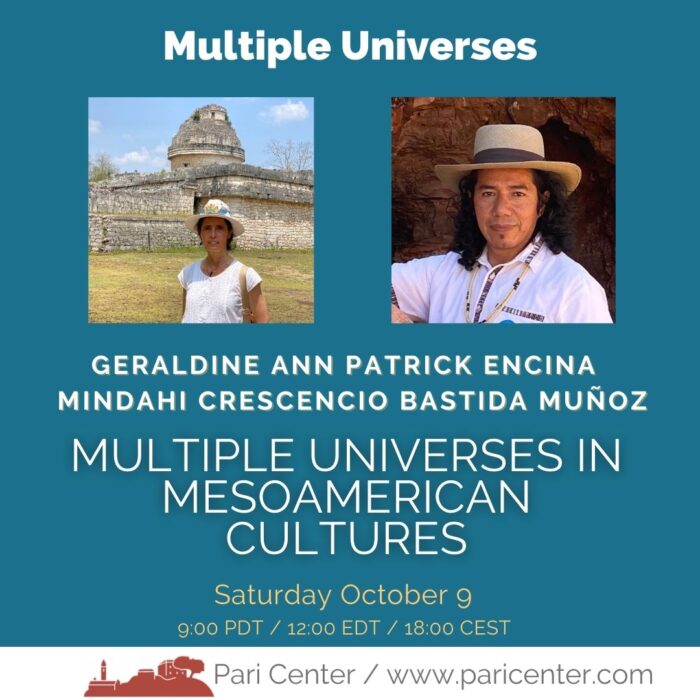
  • Multiple Universes in Mesoamerican Cultures

    Multiple Universes
    Online

    Drs Mindahi Bastida and Geraldine Patrick will share about the cosmovision of Mesoamerican cultures, where multiple simultaneous worlds are understood to exist. They will draw from different representations of such worlds and will also share personal experiences where they have had a glimpse into such alternate dimensions.

    €18,00
  • May the Force Be Among Us

    Multiple Universes
    Online

    We will use these movies to explore the concept of ‘Symphonicity,’ a new way to see synchronicity on a collective level.  and learn how to extract Archetypal Ideas from the projection of our collective archetypical field on the screen that help inspire us in creativity in our lives.

    We will then create a game to learn together the necessity of meeting the Unexpected and the necessary chances in our lives by using Arrival and a mystery movie.

    €18,00
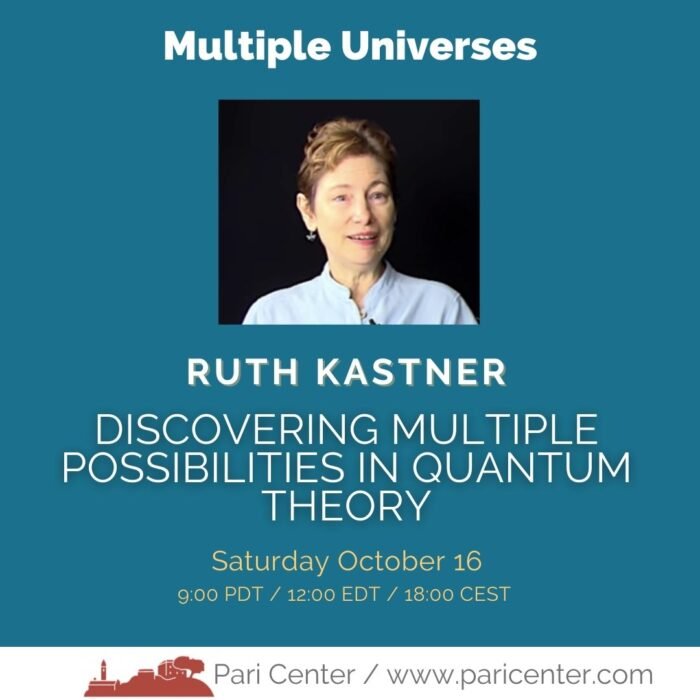
  • Discovering Multiple Possibilities in Quantum Theory

    Multiple Universes
    Online

    In her presentation Ruth will discuss the need for a paradigm change in the way we think about the world. When she says ‘we,’ she means primarily the Western scientific tradition and its attendant metaphysical and epistemological background assumptions, which have led to intractable problems in making sense of quantum theory. Among the assumptions leading us into this cul-de-sac are the empiricist notion that anything real must be tangible, and the Democritan notions that (1) a container called ‘spacetime’ is the delimiter for all real objects and that (2) real entities are separable, localizable ‘things’ that move from place to place in a local manner (as opposed to processes).

    €18,00
  • Science, Philosophy, Evidence, Explanation and Fine-Tuning

    Multiple Universes
    Online

    Various sorts of “multiverse” scenario force us to reflect both on the aims of physics and on the sorts of considerations that can make a theory credible. This topic has been somewhat suppressed in the physics community by the prevalence of operationist and instrumentalist rhetoric (“Shut Up And Calculate”). I will survey the situation with respect to how multiverse theories could address fine-tuning problems, and the challenges that remain in making the principles used for assessing credibility clear and explicit.

    €18,00
  • Imagined Problems: Real Opportunities

    Online

    The science of perception tells us that our problems are subjective and socially constructed. So what is a “real” problem, and what solutions become available to us?  In this engaging session, Drs. Susanna Wu-Pong Calvert, MAPP, PhD and Gary Goldberg, MD discuss the nature of perception and “reality” in our VUCA world (volatile, uncertain, complex, and ambiguous). They will also discuss how to move from feelings of overwhelm and despair to inspiration and agency by accessing our deep, inner wisdom. Joseph Campbell’s Hero’s Journey will be presented as a timeless, increasingly relevant, and useful frame for our individual and collective pursuit of meaning and authentic, impactful action, especially in light of our modern challenges.

    Free
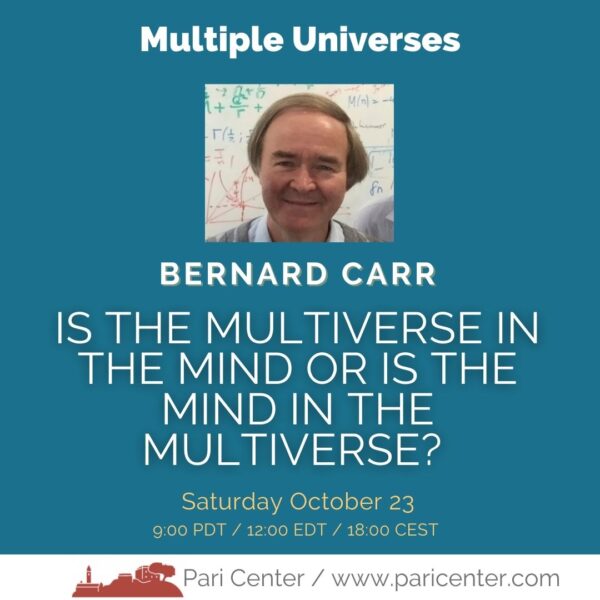
  • Is the Multiverse in the Mind or is the Mind in the Multiverse?

    Multiple Universes
    Online

    Physics has been triumphant in understanding the vast array of structures in the universe and the forces which link the microscopic and macroscopic domains. This link culminates in the big bang, where the very small (M-theory) meets the very large (the multiverse). The history of physics might also be regarded as the expansion of our consciousness to ever larger and smaller scales. However, at each stage the micro and macro frontiers have been regarded as bordering on philosophy because of the lack of empirical data. So does the merging of the two physics/philosophy borders at the big bang indicate the end of physics or the need for a radically new paradigm. I take the latter view and argue that a feature of the next paradigm must be an expansion of physics to accommodate mind and consciousness.

    €120,00
  • Closing Panel: Multiple Universes

    Multiple Universes
    Online

    A panel discussion with some of the speakers of the Multiple Universes series will close the event, reflecting on the various perspectives that have emerged in the presentations and comparing different world views.

    The session will begin by posing the panelists a few key questions to start the discussion. It will continue as a Q&A session open to everybody. You are invited to have your questions and comments ready, and in formulating them please be mindful of other people’s need to ask their own questions! The best questions are often the most concise ones.

    €18,00
  • The Consciousness of Neuroscience

    The scientific study of consciousness used to be taboo just a few decades ago, but it is now in its heyday. Consciousness research captures the imagination of laypeople, attracts research funding, and sells books. Amongst neuroscientists, the dominant position is this: whatever consciousness is, it must somehow emerge somewhere in the brain. Where else could it be? The challenge then is to find out how subjective experience springs from neural activity. But does it? By what kind of modern alchemy is the water of the matter supposed to be transformed into the wine of experience? We are never told. Instead, materialism excels at selling old metaphysical commitments as new scientific data. In addition, materialism is promissory by necessity: the grand resolution is at hand but always lies ahead – the best is yet to come.

    Free