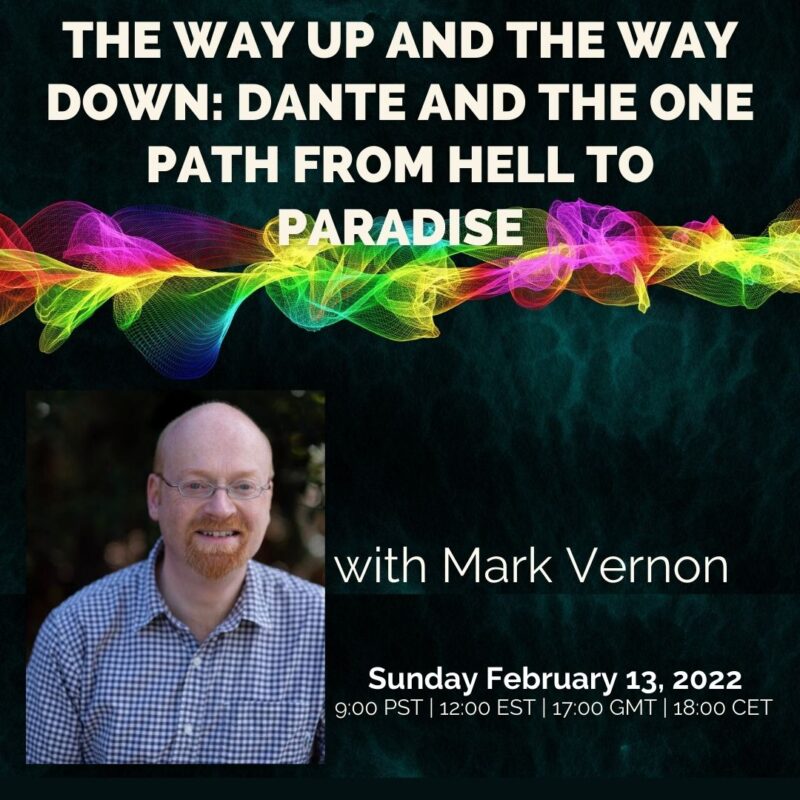
• The Way Up and the Way Down: Dante and the One Path from Hell to Paradise

    Dualities
    Online

    Dante’s Divine Comedy famously opens with the poet wakening in a dark wood. His life has seemingly taken a wrong turn. But why must he embark first on a journey through hell, before ascending Mount Purgatory, only then entering paradise? What has the way into darkness to do with the way into light? He learns to say ‘yes’ to all of reality, and that the light includes the darkness, even as tragedy is integrated into the comedy of divine life.

    €15,00
  • Connecting the Actuality of Things in Space-Time to the Reality of Possibility in QuantumLand

    Dualities
    Online

    In their joint presentation, Ruth and Gary will examine convergent trends across multiple disciplines indicating a fundamental paradigm shift is necessary and underway.  The dominant Nominalistic perspective focuses only on phenomena that are detectable through empirical observation of discrete ‘things’ and ‘events’ situated in space-time, and sees reality as exclusively constituted as such, maintaining that potentiality is not real.  There is a fundamental ‘threat’ inherent in such a worldview. What is ignored—to our peril—is the underlying matrix of relational reality, an ‘Implicate Order’ that sculpts out the possibilities that are offered for actualization out of a primordial flowing continuum, a hidden potent realm of streaming quantum process that we will call ‘QuantumLand’ for reasons that will be explained.

    €15,00
  • Contraries and Human Existence: William Blake and Cleansing the Doors of Perceptions

    Dualities
    Online

    Sight is found in the struggles of life, William Blake realised, as his own life was lived between heaven and hell, innocence and experience, vision and labour. Opposites are the energy of the imagination and bring the power to see through surfaces. Blake offers maps that chart the transformation from the narrow sight of Ulro to the full embrace of Eternity. We will also consider the role of dualities in Romantic philosophers like Samuel Taylor Coleridge.

    €15,00
  • The Future Scientist – A Conversation with Rupert Sheldrake

    The Future Scientist – A Conversation Series
    Online

    After a brief discussion of the issues raised by dogmatism within mainstream materialism and accusations of heresy by orthodox institutional science, in this second conversation we will address weak points in contemporary science in areas that might be more promising for breakthroughs, accelerating a change of paradigm already under way, and leading to a more comprehensive and inclusive worldview.

    €5,00
  • Beyond Dualistic Mind: Journeying Together on David Bohm’s ‘No Road’

    Dualities
    Online

    The Heart Sutra, taken from ancient Buddhism, concludes with this evocation of awakening, “gone, gone, gone to the farthest shore….”

    ‘This shore’ and ‘the other shore’, nowadays, have become common metaphors in spiritual discourse, ‘this side’ (here) representing the field of fragmented mind with its conflict of opposing dualities; ‘the other side’ (there) reflecting wholeness; the gap between these two signifying the great divide between this and that. But, as sages and mystics also have indicated, when one reaches the other side, he/she may find that it is this side—that always it has been this side, but now is differently perceived. This journey to perception is the journey beyond duality.

    €15,00
  • The Master and the Emissary. Dualities in the Philosophy of Iain McGilchrist

    Dualities
    Online

    The recent work of the psychiatrist and philosopher, Iain McGilchrist, allows us to bring the role of dualities in spiritual perception right up to date. He has shown how brain lateralisation facilitates two types of perception. They are asymmetric, both required in right relation for the fullest awareness of the world, which is so often lacking in our times. In this session we will weave in insights from Carl Jung and process theology too.

    €15,00
  • Music and Numbers

    The Quintessence of Music
    Online

    This two-hour, fully interactive webinar will introduce the harmonic series and the musical intervals produced by it; the way a scale and its associated harmonic scheme and thence, the musical structures that depend upon this harmony, are derived from it; consider the significance and symbolism of the number five (quinta; cinque) and the so-called “fifth element” in the realm of music; discuss the notion of cadence and its role in Western European Art Music structures; explore the role of the Fibonacci Series in musical structure; and analyse and present in performance the music of several composers, beginning, as always, with Johann Sebastian Bach, discussing the interval relationships in Das Wohltemperierte Klavier  Vol. I Prelude in C major BWV 846.

    Free
  • Jung’s Two Personalities: Psychological Implications

    Dualities
    Online

    In his book, Two Souls Alas: Jung’s Two Personalities and the Making of Analytical Psychology (2019), Mark Saban looksinto the way Jung uses his memoir to describe the experience of having two personalities. Saban argues there that Jung’s experience of the dynamic between these two personalities informs basic principles behind the development of Jung’s psychological model and indeed Jung’s entire mature psychology. He suggests that what Jung took from this experience was the principle that psychological health required the avoidance of one-sidedness and that this was achieved through the experience of tension between what Jung described as two conflicting personalities.

    €15,00
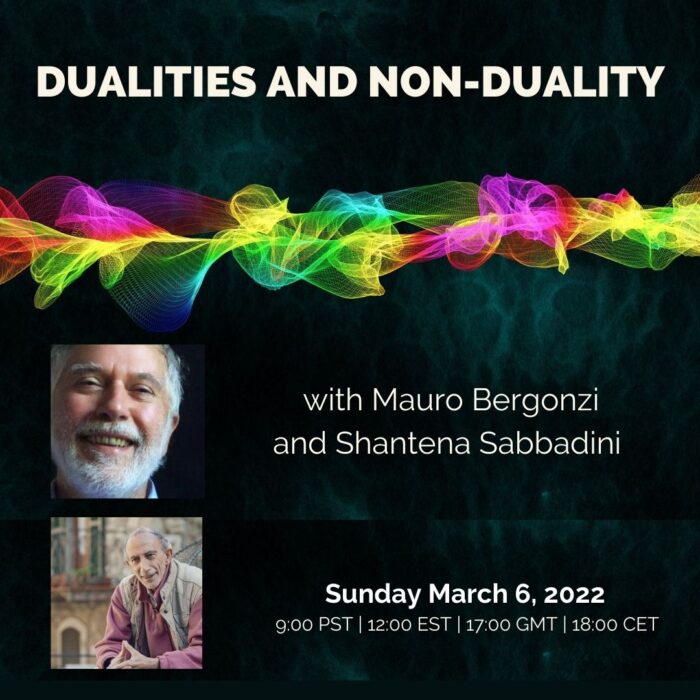
  • Dualities and Non-Duality

    Dualities
    Online

    What is the ultimate nature of reality? In our contemporary scientific culture reality appears to consist of a multiplicity of interacting parts. That multiplicity exhibits some fundamental dualities: being and becoming, particle and field, mind and matter.

    On the other hand the main stance of non-duality (advaita in sanskrit) points to the simple fact that in reality there are endless differences, but no separation at all: reality is regarded as an indivisible whole, while the perception of isolated entities is just a mental construct without any cogent ontological foundation (including the idea of a separate ‘ego’ dwelling ‘within’ a single body/mind).

    €15,00
  • An Introduction to Gregory Bateson’s Ecology of Mind

    Online

    Jon Goodbun’s research focuses on ‘ecological thinking’—both in terms of how we think about ecological systems, and how ecological systems themselves think—drawing in particular on his extensive study of the work of the ecological anthropologist Gregory Bateson. In this talk Goodbun will introduce some of the history and thinking of this important theorist, drawing in particular upon some of the ideas contained within his first collection of essays: Steps to an Ecology of Mind, as well as his later synthesis: Mind and Nature—A Necessary Unity, and his final incomplete text, published after his death by daughter Mary Catherine Bateson, called Angels Fear—Towards an Epistemology of the Sacred, and will situate these ideas in relation to more recent research, and the wider research interests of the Pari Center.

    Free