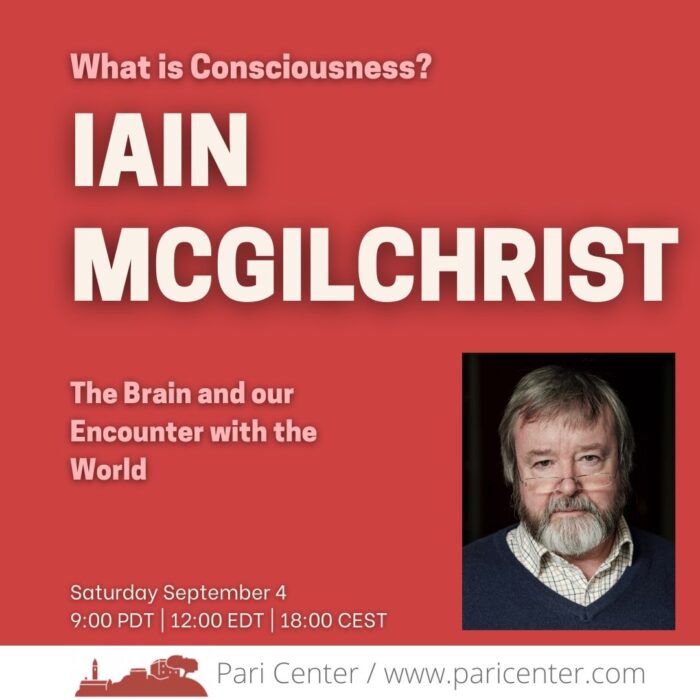
• The Brain and our Encounter with the World

    Online

    At the very least, our brains help to shape our consciousness. Can an examination of the way in which they do so help us to reconcile different visons of ourselves and of our world?  There is nothing reductionist about asking such a question: rather, McGilchrist shall suggest, it helps us to transcend the limitations of reductionism itself.  Importantly it may, for the first time, give philosophy a basis for judging certain views on the world as worthier of acceptance than others.

    €7,00 – €15,00
  • Exploring the Earth-Mind

    Online

    Indigenous peoples alive today are rooted in a consciousness of Earth that once provided the guiding mode of consciousness for humans but which at this point in time most of the rest of humanity has lost. The mainstream mode of consciousness is the “anthropocentric” or human-centered mode—a consciousness of objects, causality, competition and hierarchy that focuses on the individual self and on the conflict for survival of the individual. By contrast, the holomorphic or Earth-Mind consciousness is a holistic awareness; it’s an awareness of living in dynamic balance with other beings as “relatives,” including mountains, trees, rivers, wind. It’s an awareness of the deeply metaphoric nature of our relationship to reality and of our obligation to engage in “reciprocity” with all beings, animate or inanimate.

    €60,00
  • On the Interpretation of Signs: The Search for Meaning in Music Notation

    The Quintessence of Music
    Online

    In this two-hour webinar, divided into two forty-minute presentation sessions followed by twenty minutes for questions and debate, Coleman will lead a discussion about the perception and interpretation of signs and symbols at it relates to music notation. The discourse will encircle Coleman’s Music: It IS Rocket Science and the many disciplines that inform the study and contemplation and performance of music. We will explore the history of music notation and contemplate the notion of music as language. Coleman will demonstrate at the piano the diverse performance outcomes that arise from the often confusing, different published editions of a single work. Webinar attendees will be encouraged to actively engage in discussion, and they will be provided with links to materials that can be perused in advance of the scheduled session.

    Free
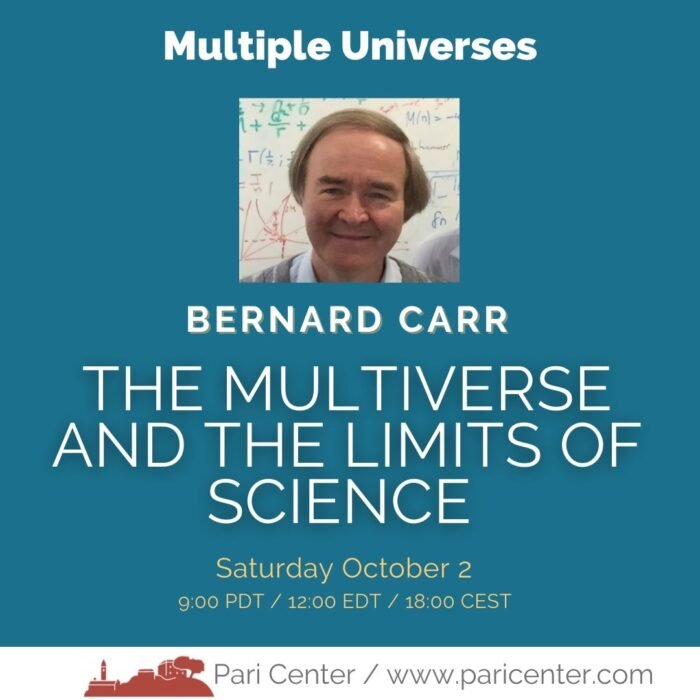
  • The Multiverse and the Limits of Science

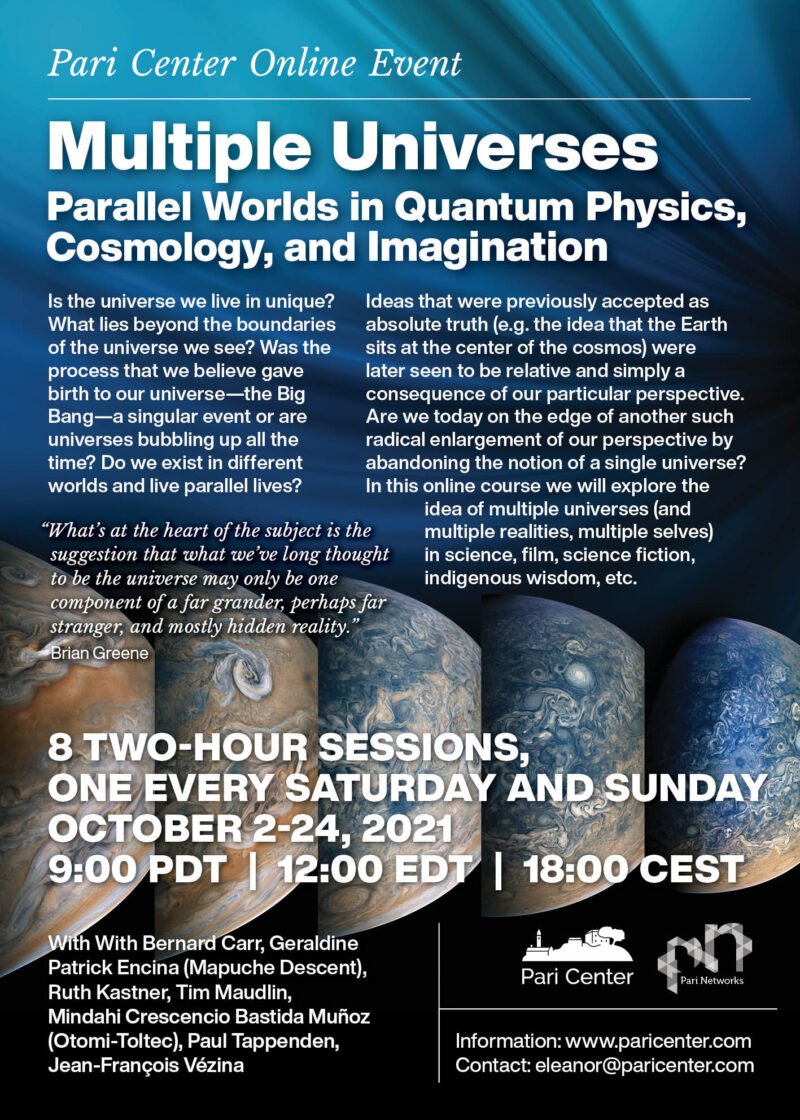
    Multiple Universes
    Online

    Developments in both cosmology and particle physics suggest that our universe may just be one member of an ensemble of universes, termed the multiverse. However, there are many different versions of the multiverse proposal, so it is important to distinguish between these in assessing the plausibility of the notion. In some versions the values of the physical constants may vary across the ensemble, so this could provide a scientific basis for the suggestion that some of the constants are fine-tuned for the existence of observers. The evidence for this comes from numerous unexplained ‘coincidences’ between the constants, a notion which used to regarded as purely philosophical or even theological.

    €18,00
  • Dendritic Quantum Mechanics

    Multiple Universes
    Online

    The advent of quantum mechanics in the 1920s brought with it the idea that fundamental physical processes may be stochastic which is to say random but constrained by probabilistic law. Rather than the future being determined in advance, as envisaged by Newtonian mechanics, one actual future is stochastically selected from a range of alternativepossibilities. A way to restore determinism to physics is to replace the idea of a stochastic process with that of a dendritic process where all (possible) outcomes actually occur, each in a different (branch) of a burgeoning quantum multiverse. The idea has been much discussed but remains very controversial. Paul explains some of the conceptual difficulties involved and how the idea may be linked to a non-standard materialist conception of the mind-body relation.

    €18,00
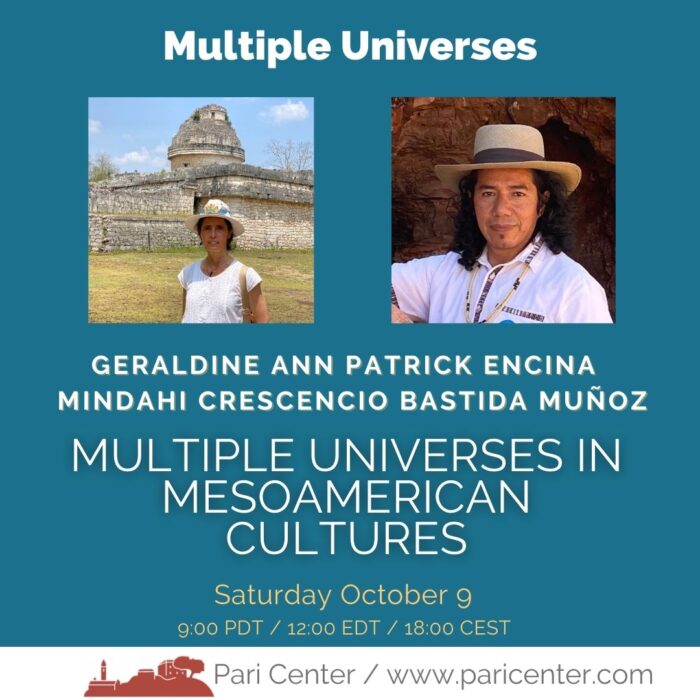
  • Multiple Universes in Mesoamerican Cultures

    Multiple Universes
    Online

    Drs Mindahi Bastida and Geraldine Patrick will share about the cosmovision of Mesoamerican cultures, where multiple simultaneous worlds are understood to exist. They will draw from different representations of such worlds and will also share personal experiences where they have had a glimpse into such alternate dimensions.

    €18,00
  • May the Force Be Among Us

    Multiple Universes
    Online

    We will use these movies to explore the concept of ‘Symphonicity,’ a new way to see synchronicity on a collective level.  and learn how to extract Archetypal Ideas from the projection of our collective archetypical field on the screen that help inspire us in creativity in our lives.

    We will then create a game to learn together the necessity of meeting the Unexpected and the necessary chances in our lives by using Arrival and a mystery movie.

    €18,00
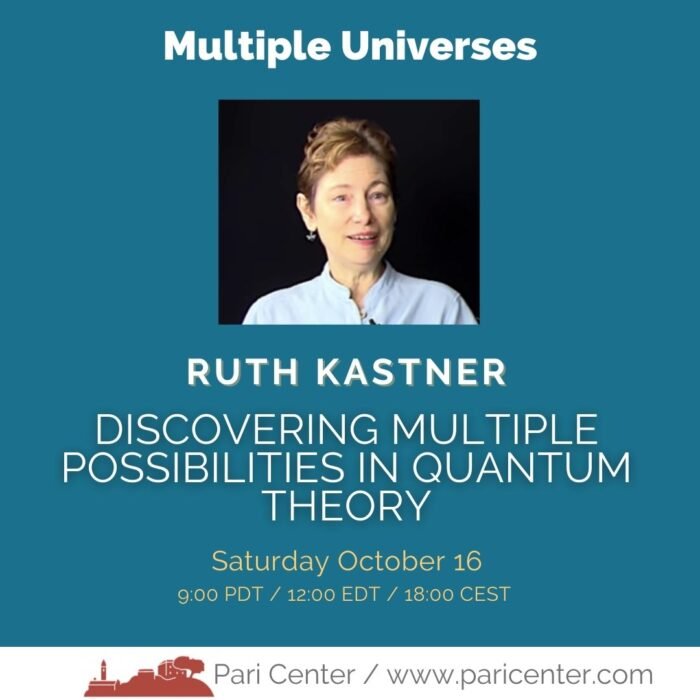
  • Discovering Multiple Possibilities in Quantum Theory

    Multiple Universes
    Online

    In her presentation Ruth will discuss the need for a paradigm change in the way we think about the world. When she says ‘we,’ she means primarily the Western scientific tradition and its attendant metaphysical and epistemological background assumptions, which have led to intractable problems in making sense of quantum theory. Among the assumptions leading us into this cul-de-sac are the empiricist notion that anything real must be tangible, and the Democritan notions that (1) a container called ‘spacetime’ is the delimiter for all real objects and that (2) real entities are separable, localizable ‘things’ that move from place to place in a local manner (as opposed to processes).

    €18,00
  • Science, Philosophy, Evidence, Explanation and Fine-Tuning

    Multiple Universes
    Online

    Various sorts of “multiverse” scenario force us to reflect both on the aims of physics and on the sorts of considerations that can make a theory credible. This topic has been somewhat suppressed in the physics community by the prevalence of operationist and instrumentalist rhetoric (“Shut Up And Calculate”). I will survey the situation with respect to how multiverse theories could address fine-tuning problems, and the challenges that remain in making the principles used for assessing credibility clear and explicit.

    €18,00