• The Master and the Emissary. Dualities in the Philosophy of Iain McGilchrist

    Dualities
    Online

    The recent work of the psychiatrist and philosopher, Iain McGilchrist, allows us to bring the role of dualities in spiritual perception right up to date. He has shown how brain lateralisation facilitates two types of perception. They are asymmetric, both required in right relation for the fullest awareness of the world, which is so often lacking in our times. In this session we will weave in insights from Carl Jung and process theology too.

    €15,00

  • Music and Numbers

    The Quintessence of Music
    Online

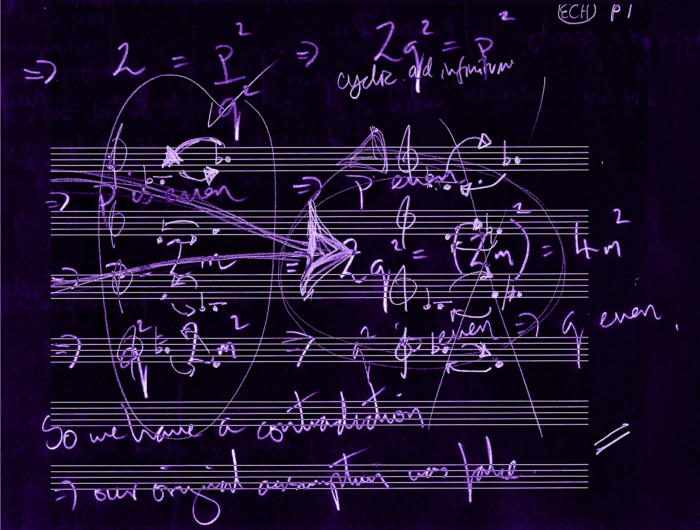
    This two-hour, fully interactive webinar will introduce the harmonic series and the musical intervals produced by it; the way a scale and its associated harmonic scheme and thence, the musical structures that depend upon this harmony, are derived from it; consider the significance and symbolism of the number five (quinta; cinque) and the so-called “fifth element” in the realm of music; discuss the notion of cadence and its role in Western European Art Music structures; explore the role of the Fibonacci Series in musical structure; and analyse and present in performance the music of several composers, beginning, as always, with Johann Sebastian Bach, discussing the interval relationships in Das Wohltemperierte Klavier  Vol. I Prelude in C major BWV 846.

    Free
  • Jung’s Two Personalities: Psychological Implications

    Dualities
    Online

    In his book, Two Souls Alas: Jung’s Two Personalities and the Making of Analytical Psychology (2019), Mark Saban looksinto the way Jung uses his memoir to describe the experience of having two personalities. Saban argues there that Jung’s experience of the dynamic between these two personalities informs basic principles behind the development of Jung’s psychological model and indeed Jung’s entire mature psychology. He suggests that what Jung took from this experience was the principle that psychological health required the avoidance of one-sidedness and that this was achieved through the experience of tension between what Jung described as two conflicting personalities.

    €15,00
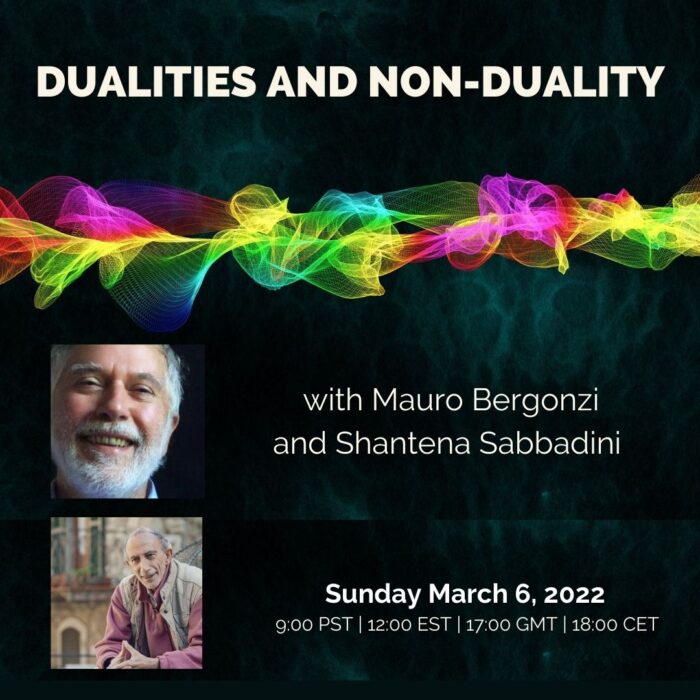
  • Dualities and Non-Duality

    Dualities
    Online

    What is the ultimate nature of reality? In our contemporary scientific culture reality appears to consist of a multiplicity of interacting parts. That multiplicity exhibits some fundamental dualities: being and becoming, particle and field, mind and matter.

    On the other hand the main stance of non-duality (advaita in sanskrit) points to the simple fact that in reality there are endless differences, but no separation at all: reality is regarded as an indivisible whole, while the perception of isolated entities is just a mental construct without any cogent ontological foundation (including the idea of a separate ‘ego’ dwelling ‘within’ a single body/mind).

    €15,00
  • An Introduction to Gregory Bateson’s Ecology of Mind

    Online

    Jon Goodbun’s research focuses on ‘ecological thinking’—both in terms of how we think about ecological systems, and how ecological systems themselves think—drawing in particular on his extensive study of the work of the ecological anthropologist Gregory Bateson. In this talk Goodbun will introduce some of the history and thinking of this important theorist, drawing in particular upon some of the ideas contained within his first collection of essays: Steps to an Ecology of Mind, as well as his later synthesis: Mind and Nature—A Necessary Unity, and his final incomplete text, published after his death by daughter Mary Catherine Bateson, called Angels Fear—Towards an Epistemology of the Sacred, and will situate these ideas in relation to more recent research, and the wider research interests of the Pari Center.

    Free
  • The Future Scientist – A Conversation with Michel Bitbol

    The Future Scientist – A Conversation Series
    Online

    Until the advent of quantum mechanics, physical sciences had thrived on the separation between object and subject that seems to provide “a view from nowhere”. At the same time, current life and mind sciences still struggle with experiments and theories in which the primacy of felt experience does not seem to matter. In this third conversation of the series we will draw from the phenomenological tradition to explore the feasibility of a new kind of science in which human consciousness is placed at the center.

    €5,00
  • Music and Numbers, Part II

    The Quintessence of Music
    Online

    This session will continue the journey we began in Music and Numbers, Part I. Having embarked upon the landscape comprised of dissonant intervals and avoidance of tonality, we will explore the music of composers working with the so-called Twelve-Tone System: Riccardo Malipiero, Anton Webern, and Luigi Dallapiccola, for whom numbers provided the pathway to their idiosyncratic musical languages. We will begin by considering the way interval relationships in Johann Sebastian Bach’s Sinfonia in F minor create what we know as consonance and compare it to Riccardo Malipiero’s (1914 Milan – 2003 Milan) Invenzione #7, a dissonant work that is modelled upon it. Dr Coleman will demonstrate the way Webern created 144 possible versions of his twelve-tone row using the Magic Square.

    Free
  • Teaching the Dinosaur to Dance: Moving Beyond Business as Usual

    Online

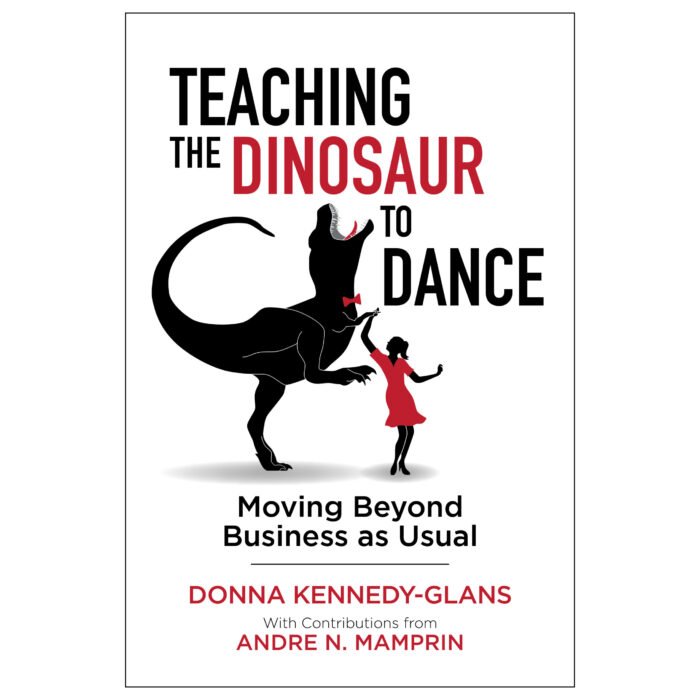
    Donna’s latest book Teaching the Dinosaur to Dance provides the roadmap builders and rebuilders—of society and of enterprise—with the tools to rethink, redesign and revitalize their organizations and to remain relevant and sustainable in a new and very different future. Business as usual is extinct. Disruption and social pressure are the new norm and change is inevitable for enterprises of all kinds—businesses, governments, non-profits, community initiatives and social institutions. We’ve reached a turning point and it’s time to evolve, or we go the way of the dinosaurs. We all need to act now to survive and find new ways to thrive in a changed world. But in an age of polarized debates on complex issues (such as fairness and climate change), how can leaders find a new way forward? How can enterprises re-invent themselves to make capitalism work better for more people? These are some of the compelling and timely issues that Donna and Julie will tackle in their conversation.

    Free
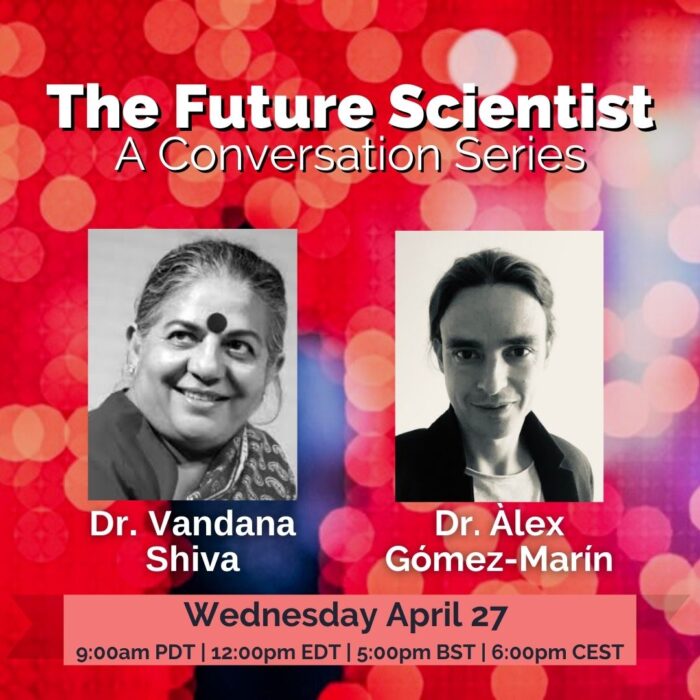
  • The Future Scientist – A Conversation with Dr Vandana Shiva

    The Future Scientist – A Conversation Series
    Online

    Science is more than an academic activity circumscribed to laboratories and seminar rooms; it is a human creative effort that has political implications and bears societal responsibilities. In this installment of The Future Scientist series, we will explore what scientists actually do, aren’t doing, and could do in the wider picture of the troubled relationship between human beings and the Earth. Drawing from science and philosophy, but also from real-world activism, we will explicitly address the pervasive and pernicious effects of the neoliberal tide and discuss how to enact reciprocal transformations at the individual and planetary levels, so as to honor the land, the feminine and, above all, mother nature. The Future Scientist shall not be the modern Prometheus.

    €5,00
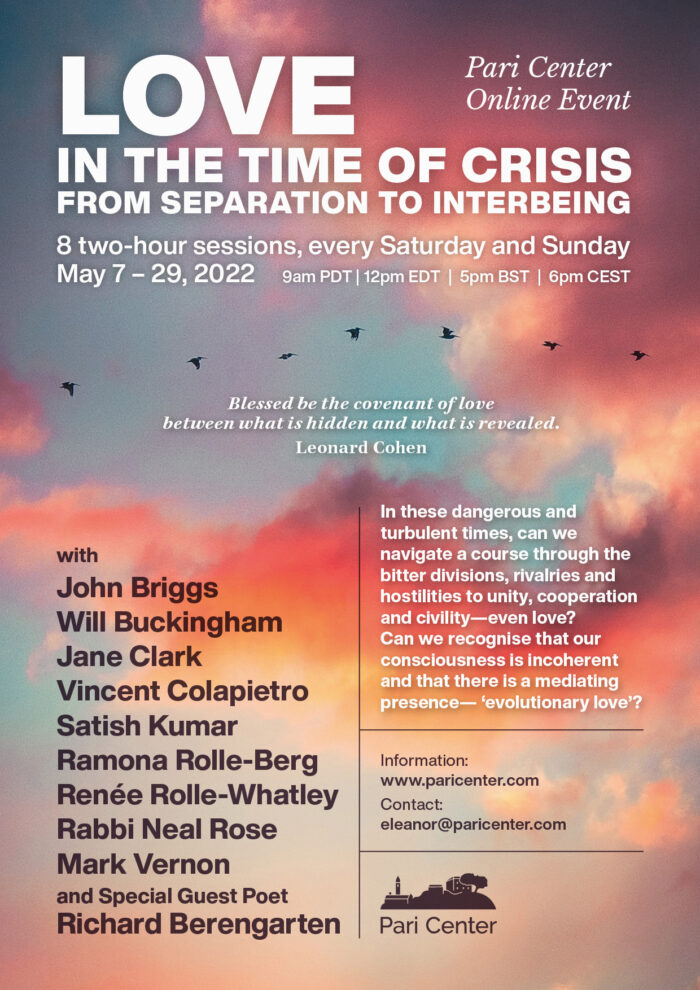
  • Love in the Time of Crisis

    Love in the Time of Crisis
    Online

    We live in a challenging time of transition which promises both hope and peril.  How are we to navigate a course that will take us from a story of separation, competition, and distrust to a new narrative of inter-being, cooperation, and love? How do we begin to give up and move beyond an incoherent and too often destructive structure of consciousness and a world which seems rarely to see the mediating presence of what has been called ‘evolutionary love’?

    €100.00